
Ch.20 - Electrochemistry
Brown - Chemistry: The Central Science 14th Edition
Brown14th EditionChemistry: The Central ScienceISBN: 9780134414232당신이 사용하는 게 아니라요?교과서 변경
20장, 문제 119

A student designs an ammeter (a device that measures electrical current) that is based on the electrolysis of water into hydrogen and oxygen gases. When electrical current of unknown magnitude is run through the device for 2.00 min, 12.3 mL of water-saturated H21g2 is collected. The temperature of the system is 25.5 °C, and the atmospheric pressure is 768 torr. What is the magnitude of the current in amperes?

검증된 단계별 안내
1
Identify the chemical reaction: The electrolysis of water produces hydrogen gas (H₂) and oxygen gas (O₂). The balanced equation is 2H₂O(l) → 2H₂(g) + O₂(g).
Determine the moles of hydrogen gas produced: Use the ideal gas law, PV = nRT, to find the moles of H₂. First, convert the volume of H₂ from mL to L, the temperature from °C to Kelvin, and the pressure from torr to atm.
Account for water vapor pressure: Since the hydrogen gas is water-saturated, subtract the vapor pressure of water at 25.5 °C from the total pressure to find the pressure of the dry hydrogen gas.
Calculate the charge passed: Use the stoichiometry of the reaction. From the balanced equation, 2 moles of electrons are required to produce 1 mole of H₂. Use Faraday's constant (96485 C/mol) to find the total charge in coulombs.
Determine the current: Use the formula I = Q/t, where I is the current in amperes, Q is the charge in coulombs, and t is the time in seconds (convert 2.00 min to seconds).

비슷한 문제에 대한 검증된 영상 답변:

이 영상 해법은 위 문제에 도움이 된다고 튜터들이 추천한 것입니다.
영상 길이:
11m
도움이 되었나요?

주요 개념

질문에 올바르게 답하기 위해 반드시 이해해야 하는 핵심 개념들은 다음과 같습니다.

Electrolysis of Water

Electrolysis of water is a chemical process that uses electrical energy to decompose water (H2O) into its constituent gases, hydrogen (H2) and oxygen (O2). This process occurs in an electrolytic cell where an electric current is passed through water containing an electrolyte, facilitating the separation of water molecules. The volume of gas produced can be measured to determine the amount of current used, as the amount of gas generated is directly proportional to the charge passed.
추천 영상:
가이드 코스
01:23
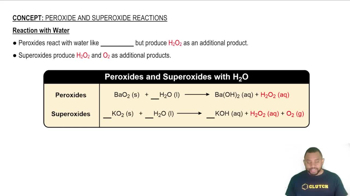
Reaction with Water

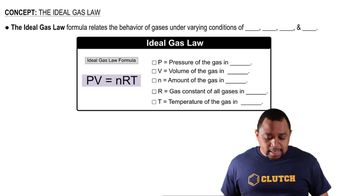
Ideal Gas Law

The Ideal Gas Law is a fundamental equation in chemistry that relates the pressure, volume, temperature, and number of moles of a gas. It is expressed as PV = nRT, where P is pressure, V is volume, n is the number of moles, R is the ideal gas constant, and T is temperature in Kelvin. This law allows for the calculation of gas quantities under varying conditions, which is essential for determining the amount of hydrogen gas produced during electrolysis in the given problem.
추천 영상:
가이드 코스
01:15
Ideal Gas Law Formula

Faraday's Laws of Electrolysis

Faraday's Laws of Electrolysis describe the relationship between the amount of substance produced at an electrode during electrolysis and the quantity of electric charge passed through the electrolyte. The first law states that the mass of a substance altered at an electrode is directly proportional to the total electric charge passed. This principle is crucial for calculating the current in the ammeter design, as it links the volume of hydrogen gas collected to the current flowing through the system over time.
추천 영상:
가이드 코스
01:40
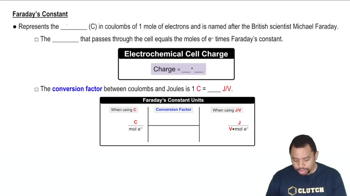
Faraday's Constant in Electrochemistry