
Ch.20 - Electrochemistry
Brown - Chemistry: The Central Science 14th Edition
Brown14th EditionChemistry: The Central ScienceISBN: 9780134414232당신이 사용하는 게 아니라요?교과서 변경
20장, 문제 118

The Ksp value for PbS(s) is 8.0 * 10^-28. By using this value together with an electrode potential from Appendix E, determine the value of the standard reduction potential for the reaction PbS(s) + 2 e^- → Pb(s) + S^2-(aq).

검증된 단계별 안내
1
Identify the dissolution reaction for PbS(s) in water: PbS(s) ⇌ Pb^{2+}(aq) + S^{2-}(aq). The solubility product constant (K_{sp}) is given for this reaction.
Write the Nernst equation for the half-reaction: PbS(s) + 2 e^- → Pb(s) + S^{2-}(aq). This involves the standard reduction potential (E°) and the reaction quotient (Q).
Use the relationship between the Gibbs free energy change (ΔG°) and the equilibrium constant (K_{sp}): ΔG° = -RT ln(K_{sp}). Calculate ΔG° using the given K_{sp} value.
Relate ΔG° to the standard reduction potential (E°) using the equation: ΔG° = -nFE°, where n is the number of moles of electrons transferred (n=2 for this reaction) and F is the Faraday constant.
Solve for the standard reduction potential (E°) using the calculated ΔG° and the relationship ΔG° = -nFE°.

주요 개념

질문에 올바르게 답하기 위해 반드시 이해해야 하는 핵심 개념들은 다음과 같습니다.

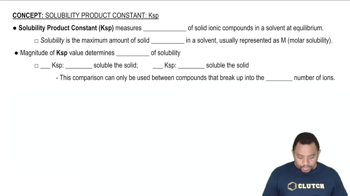
Solubility Product Constant (Ksp)

The solubility product constant (Ksp) is an equilibrium constant that applies to the solubility of sparingly soluble ionic compounds. It represents the product of the molar concentrations of the ions, each raised to the power of their coefficients in the balanced equation. For PbS, Ksp = [Pb^2+][S^2-], and a low Ksp value indicates that the compound is not very soluble in water.
추천 영상:
가이드 코스
01:47
Solubility Product Constant

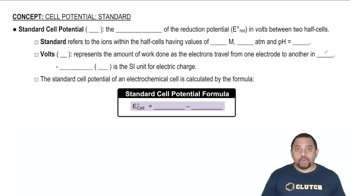
Electrode Potential

Electrode potential is a measure of the tendency of a chemical species to be reduced, expressed in volts. It is determined under standard conditions and is crucial for predicting the direction of redox reactions. The standard reduction potential for a half-reaction can be found in tables, and it helps in calculating the overall cell potential when combined with other half-reactions.
추천 영상:
가이드 코스
01:27
Standard Cell Potential

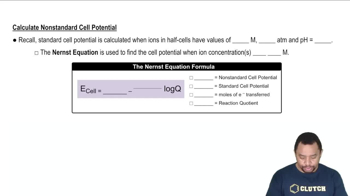
Nernst Equation

The Nernst equation relates the reduction potential of a half-cell to the concentrations of the reactants and products involved in the reaction. It allows for the calculation of the cell potential under non-standard conditions. This equation is essential for determining how changes in concentration affect the electrode potential, which is necessary for solving the given problem involving PbS.
추천 영상:
가이드 코스
01:17
The Nernst Equation
관련 실천
교과서 질문

Cytochrome, a complicated molecule that we will represent as CyFe2+, reacts with the air we breathe to supply energy required to synthesize adenosine triphosphate (ATP). The body uses ATP as an energy source to drive other reactions (Section 19.7). At pH 7.0 the following reduction potentials pertain to this oxidation of CyFe2+: O21g2 + 4 H+1aq2 + 4 e- ¡ 2 H2O1l2 Ered ° = +0.82 V CyFe3+1aq2 + e- ¡ CyFe2+1aq2 E°red = +0.22 V (a) What is ∆G for the oxidation of CyFe2+ by air? (b) If the synthesis of 1.00 mol of ATP from adenosine diphosphate (ADP) requires a ∆G of 37.7 kJ, how many moles of ATP are synthesized per mole of O2?

382
views
교과서 질문

A student designs an ammeter (a device that measures electrical current) that is based on the electrolysis of water into hydrogen and oxygen gases. When electrical current of unknown magnitude is run through the device for 2.00 min, 12.3 mL of water-saturated H21g2 is collected. The temperature of the system is 25.5 °C, and the atmospheric pressure is 768 torr. What is the magnitude of the current in amperes?

655
views
교과서 질문

Cytochrome, a complicated molecule that we will represent as CyFe2+, reacts with the air we breathe to supply energy required to synthesize adenosine triphosphate (ATP). The body uses ATP as an energy source to drive other reactions (Section 19.7). At pH 7.0 the following reduction potentials pertain to this oxidation of CyFe2+: O21g2 + 4 H+1aq2 + 4 e- ¡ 2 H2O1l2 Ered ° = +0.8 (b) If the synthesis of 1.00 mol of ATP from adenosine diphosphate (ADP) requires a ∆G of 37.7 kJ, how many moles of ATP are synthesized per mole of O2?

536
views