
Ch.20 - Electrochemistry
Brown - Chemistry: The Central Science 14th Edition
Brown14th EditionChemistry: The Central ScienceISBN: 9780134414232당신이 사용하는 게 아니라요?교과서 변경
20장, 문제 67a

A voltaic cell utilizes the following reaction: 4 Fe2+1aq2 + O21g2 + 4 H+1aq2 ¡ 4 Fe3+1aq2 + 2 H2O1l2 (a) What is the emf of this cell under standard conditions?

검증된 단계별 안내
1
The given overall reaction can be split into two half-reactions. The oxidation half-reaction involves Fe^{2+} being oxidized to Fe^{3+}, and the reduction half-reaction involves O_2 being reduced to H_2O.
The oxidation half-reaction is: 4 \(\text{Fe}\)^{2+} \(\rightarrow\) 4 \(\text{Fe}\)^{3+} + 4e^{-}.
The reduction half-reaction is: O_2 + 4H^{+} + 4e^{-} \(\rightarrow\) 2H_2O.
Look up the standard reduction potentials (E^\(\circ\)) for each half-reaction in a standard reduction potential table. The standard reduction potential for Fe^{3+}/Fe^{2+} and O_2/H_2O will be needed.
Use the formula E^\(\circ\)_{cell} = E^\(\circ\)_{cathode} - E^\(\circ\)_{anode}, where the cathode is the reduction half-reaction and the anode is the oxidation half-reaction.>

비슷한 문제에 대한 검증된 영상 답변:

이 영상 해법은 위 문제에 도움이 된다고 튜터들이 추천한 것입니다.
영상 길이:
4m

주요 개념

질문에 올바르게 답하기 위해 반드시 이해해야 하는 핵심 개념들은 다음과 같습니다.

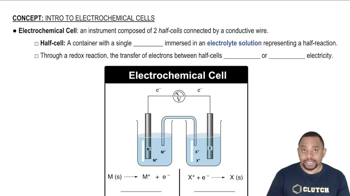
Electrochemical Cells

Electrochemical cells are devices that convert chemical energy into electrical energy through redox reactions. A voltaic cell, specifically, generates electricity spontaneously from a chemical reaction, involving oxidation and reduction processes occurring in separate half-cells. Understanding the structure and function of these cells is crucial for analyzing their emf (electromotive force) and overall efficiency.
추천 영상:
가이드 코스
02:46
Electrochemical Cells

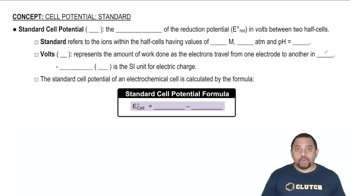
Standard Electrode Potentials

Standard electrode potentials are measured voltages that indicate the tendency of a species to be reduced, measured under standard conditions (1 M concentration, 1 atm pressure, and 25°C). These values are essential for calculating the emf of a voltaic cell using the Nernst equation or by subtracting the reduction potential of the anode from that of the cathode. Knowing these potentials allows for the prediction of the direction of electron flow in the cell.
추천 영상:
가이드 코스
01:27
Standard Cell Potential

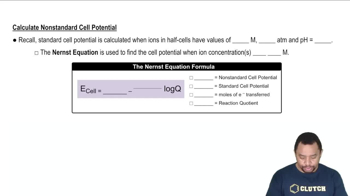
Nernst Equation

The Nernst equation relates the emf of an electrochemical cell to the standard electrode potentials and the concentrations of the reactants and products. It is expressed as E = E° - (RT/nF) ln(Q), where E° is the standard emf, R is the gas constant, T is the temperature in Kelvin, n is the number of moles of electrons transferred, F is Faraday's constant, and Q is the reaction quotient. This equation is vital for calculating the emf under non-standard conditions.
추천 영상:
가이드 코스
01:17
The Nernst Equation