Ch.21 - Nuclear Chemistry
Brown - Chemistry: The Central Science 14th Edition
Brown14th EditionChemistry: The Central ScienceISBN: 9780134414232당신이 사용하는 게 아니라요?교과서 변경
21장, 문제 83

A 26.00-g sample of water containing tritium, ³¹H, emits 1.50 * 10³ beta particles per second. Tritium is a weak beta emitter with a half-life of 12.3 years. What fraction of all the hydrogen in the water sample is tritium?

검증된 단계별 안내
1
Step 1: Calculate the number of moles of water in the 26.00-g sample. Use the molar mass of water (H₂O), which is approximately 18.02 g/mol, to find the moles: \( \text{moles of water} = \frac{26.00 \text{ g}}{18.02 \text{ g/mol}} \).
Step 2: Determine the total number of hydrogen atoms in the water sample. Since each water molecule (H₂O) contains 2 hydrogen atoms, multiply the moles of water by Avogadro's number (6.022 \(\times\) 10^{23} \(\text{ molecules/mol}\)) and then by 2.
Step 3: Calculate the decay constant (\( \lambda \)) for tritium using its half-life. The decay constant is given by \( \lambda = \frac{0.693}{\text{half-life}} \), where the half-life is 12.3 years. Convert the half-life to seconds for consistency with the decay rate.
Step 4: Use the decay rate formula \( R = N \lambda \) to find the number of tritium atoms (N) in the sample. Here, R is the decay rate (1.50 \(\times\) 10^3 \(\text{ beta particles/second}\)). Rearrange the formula to solve for N: \( N = \frac{R}{\lambda} \).
Step 5: Calculate the fraction of hydrogen that is tritium by dividing the number of tritium atoms (N) by the total number of hydrogen atoms calculated in Step 2.

주요 개념

질문에 올바르게 답하기 위해 반드시 이해해야 하는 핵심 개념들은 다음과 같습니다.

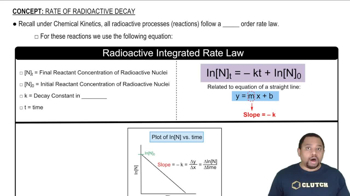
Radioactive Decay

Radioactive decay is the process by which unstable atomic nuclei lose energy by emitting radiation. This can occur in various forms, including alpha, beta, and gamma decay. In the case of tritium, it undergoes beta decay, where a neutron is converted into a proton, resulting in the emission of a beta particle. Understanding this process is crucial for calculating the amount of tritium remaining in a sample over time.
추천 영상:
가이드 코스
03:00
Rate of Radioactive Decay

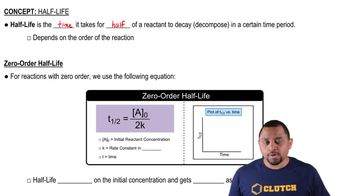
Half-Life

Half-life is the time required for half of the radioactive nuclei in a sample to decay. For tritium, the half-life is 12.3 years, meaning that after this period, only half of the original amount of tritium will remain. This concept is essential for determining how much tritium is present in the water sample after a certain period, allowing for calculations related to its decay and current quantity.
추천 영상:
가이드 코스
02:17
Zero-Order Half-life

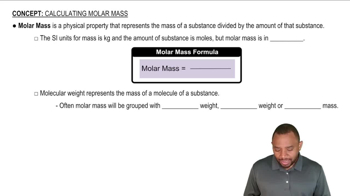
Molar Mass and Composition

Molar mass is the mass of one mole of a substance, typically expressed in grams per mole. Water (H₂O) has a molar mass of approximately 18.02 g/mol, with hydrogen contributing about 2.02 g/mol. To find the fraction of tritium in the water sample, one must calculate the total amount of hydrogen present and compare it to the amount of tritium, which requires understanding the composition of the sample and the molar mass of tritium.
추천 영상:
가이드 코스
02:11
Molar Mass Concept