Ch.21 - Nuclear Chemistry
Brown - Chemistry: The Central Science 14th Edition
Brown14th EditionChemistry: The Central ScienceISBN: 9780134414232당신이 사용하는 게 아니라요?교과서 변경
21장, 문제 84

The Sun radiates energy into space at the rate of 3.9 * 1026 J/s. (a) Calculate the rate of mass loss from the Sun in kg/s. (b) How does this mass loss arise? (c) It is estimated that the Sun contains 9 * 1056 free protons. How many protons per second are consumed in nuclear reactions in the Sun?

검증된 단계별 안내
1
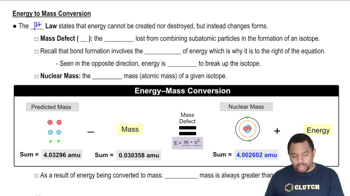
Step 1: To find the rate of mass loss from the Sun in kg/s, use Einstein's mass-energy equivalence principle, E=mc^2, where E is energy, m is mass, and c is the speed of light (approximately 3.00 x 10^8 m/s). Rearrange the formula to solve for mass: m = E/c^2.
Step 2: Substitute the given energy rate (3.9 x 10^26 J/s) into the equation from Step 1 to calculate the rate of mass loss. This will give you the mass loss in kg/s.
Step 3: For part (b), understand that the mass loss arises from nuclear fusion reactions occurring in the Sun's core, where hydrogen nuclei (protons) fuse to form helium, releasing energy in the process.
Step 4: To find how many protons per second are consumed, first determine the energy released per fusion reaction. Typically, the fusion of four protons into one helium nucleus releases about 26.7 MeV of energy.
Step 5: Convert the energy released per reaction from MeV to joules, then divide the total energy output of the Sun (3.9 x 10^26 J/s) by the energy per reaction to find the number of reactions per second. Since each reaction consumes four protons, multiply the number of reactions by four to find the number of protons consumed per second.

주요 개념

질문에 올바르게 답하기 위해 반드시 이해해야 하는 핵심 개념들은 다음과 같습니다.

Einstein's Mass-Energy Equivalence

Einstein's mass-energy equivalence principle, expressed as E=mc², states that energy (E) and mass (m) are interchangeable; they are different forms of the same thing. This principle is crucial for understanding how the Sun converts mass into energy through nuclear fusion, allowing us to calculate the rate of mass loss based on the energy output.
추천 영상:
가이드 코스
04:12
Energy to Mass Conversion

Nuclear Fusion in the Sun

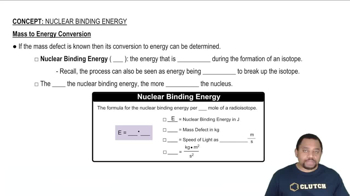
Nuclear fusion is the process by which two light atomic nuclei combine to form a heavier nucleus, releasing energy in the process. In the Sun, hydrogen nuclei fuse to form helium, which is the primary source of the Sun's energy. This process not only generates energy but also results in a gradual loss of mass, which can be quantified.
추천 영상:
가이드 코스
02:06
Nuclear Binding Energy

Rate of Reaction and Particle Consumption

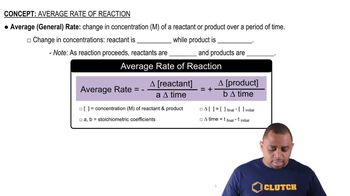
The rate of reaction in nuclear processes, such as those occurring in the Sun, can be determined by the energy produced and the number of particles involved. By knowing the total energy output and the energy released per fusion reaction, we can calculate how many protons are consumed per second, providing insight into the Sun's longevity and energy production.
추천 영상:
가이드 코스
02:03
Average Rate of Reaction