Ch.21 - Nuclear Chemistry
Brown - Chemistry: The Central Science 14th Edition
Brown14th EditionChemistry: The Central ScienceISBN: 9780134414232당신이 사용하는 게 아니라요?교과서 변경
21장, 문제 63

A portion of the Sun’s energy comes from the reaction 4 11H → 42He + 2 0-1e, which requires a temperature of 106 to 107 K. Use the mass of the helium-4 nucleus given in Table 21.7 to determine how much energy is released per mol of hydrogen atoms.

검증된 단계별 안내
1
Step 1: Identify the nuclear reaction involved. The reaction is 4 protons (hydrogen nuclei) combining to form one helium-4 nucleus and two positrons.
Step 2: Determine the mass defect. Calculate the difference in mass between the reactants (4 hydrogen nuclei) and the products (1 helium-4 nucleus and 2 positrons). Use the given mass of the helium-4 nucleus and standard masses for protons and positrons.
Step 3: Convert the mass defect to energy. Use Einstein's equation, \( E = \Delta m c^2 \), where \( \Delta m \) is the mass defect and \( c \) is the speed of light, to find the energy released per reaction.
Step 4: Calculate the energy per mole. Since the reaction involves 4 hydrogen atoms, convert the energy per reaction to energy per mole by multiplying by Avogadro's number (\( 6.022 \times 10^{23} \) mol\(^{-1}\)).
Step 5: Summarize the result. The final step is to express the energy released per mole of hydrogen atoms in appropriate units, such as kilojoules per mole (kJ/mol).

주요 개념

질문에 올바르게 답하기 위해 반드시 이해해야 하는 핵심 개념들은 다음과 같습니다.

Nuclear Fusion

Nuclear fusion is the process by which two light atomic nuclei combine to form a heavier nucleus, releasing energy in the process. In the context of the Sun, hydrogen nuclei (protons) fuse to form helium, which is the primary source of the Sun's energy. This reaction occurs under extreme temperatures and pressures, allowing the strong nuclear force to overcome the electrostatic repulsion between positively charged protons.
추천 영상:
가이드 코스
02:06
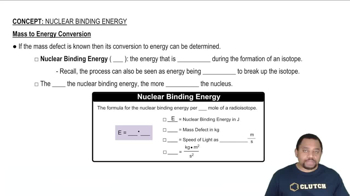
Nuclear Binding Energy

Mass-Energy Equivalence

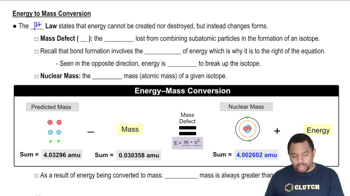
Mass-energy equivalence, encapsulated in Einstein's equation E=mc², states that mass can be converted into energy and vice versa. In nuclear reactions, a small amount of mass is lost when nuclei fuse, and this mass is converted into a significant amount of energy. Understanding this principle is crucial for calculating the energy released during fusion reactions, such as the one occurring in the Sun.
추천 영상:
가이드 코스
04:12
Energy to Mass Conversion

Molar Mass and Energy Calculations

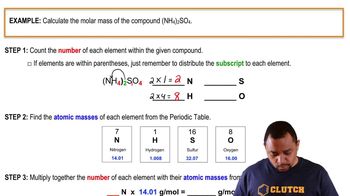
Molar mass is the mass of one mole of a substance, typically expressed in grams per mole. To determine the energy released per mole of hydrogen atoms in the fusion reaction, one must use the molar mass of the reactants and products, along with the energy released per reaction. This involves converting the mass defect (the difference in mass before and after the reaction) into energy using the mass-energy equivalence principle.
추천 영상:
가이드 코스
03:12
Molar Mass Calculation Example