
Ch.21 - Nuclear Chemistry
Brown - Chemistry: The Central Science 14th Edition
Brown14th EditionChemistry: The Central ScienceISBN: 9780134414232당신이 사용하는 게 아니라요?교과서 변경
21장, 문제 42

A wooden artifact from a Chinese temple has a 14C activity of 38.0 counts per minute as compared with an activity of 58.2 counts per minute for a standard of zero age. From the half-life for 14C decay, 5715 years, determine the age of the artifact.

검증된 단계별 안내
1
Step 1: Understand the concept of radioactive decay and the use of carbon-14 dating. Carbon-14 dating is used to determine the age of an artifact by comparing its current 14C activity to that of a standard of zero age.
Step 2: Use the formula for radioactive decay: \( N(t) = N_0 e^{-\lambda t} \), where \( N(t) \) is the current activity, \( N_0 \) is the initial activity, \( \lambda \) is the decay constant, and \( t \) is the time elapsed.
Step 3: Calculate the decay constant \( \lambda \) using the half-life formula: \( \lambda = \frac{\ln(2)}{\text{half-life}} \). Substitute the given half-life of 5715 years into the formula.
Step 4: Rearrange the decay formula to solve for \( t \): \( t = \frac{1}{\lambda} \ln\left(\frac{N_0}{N(t)}\right) \). Substitute the given activities (38.0 counts per minute for the artifact and 58.2 counts per minute for the standard) into the equation.
Step 5: Calculate \( t \) to find the age of the artifact. This will give you the time elapsed since the artifact had the same 14C activity as the standard of zero age.

주요 개념

질문에 올바르게 답하기 위해 반드시 이해해야 하는 핵심 개념들은 다음과 같습니다.

Radiocarbon Dating

Radiocarbon dating is a method used to determine the age of organic materials by measuring the amount of carbon-14 (14C) remaining in a sample. 14C is a radioactive isotope of carbon that is formed in the atmosphere and taken up by living organisms. When an organism dies, it stops absorbing 14C, and the isotope begins to decay at a known rate, characterized by its half-life.

Half-Life

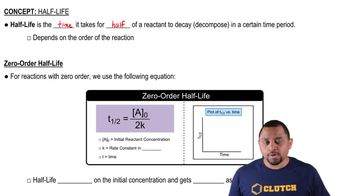
The half-life of a radioactive isotope is the time required for half of the isotope in a sample to decay. For 14C, the half-life is approximately 5715 years. This concept is crucial for calculating the age of an artifact, as it allows us to determine how many half-lives have passed since the organism's death based on the remaining activity of 14C in the sample.
추천 영상:
가이드 코스
02:17
Zero-Order Half-life

Exponential Decay

Exponential decay describes the process by which a quantity decreases at a rate proportional to its current value. In the context of radioactive decay, the activity of a radioactive substance decreases exponentially over time. The relationship can be expressed mathematically, allowing for the calculation of the age of an artifact by comparing its current activity to that of a standard reference.
추천 영상: