Ch.21 - Nuclear Chemistry
Brown - Chemistry: The Central Science 14th Edition
Brown14th EditionChemistry: The Central ScienceISBN: 9780134414232당신이 사용하는 게 아니라요?교과서 변경
21장, 문제 11

What is the symbol for (a) a neutron?

검증된 단계별 안내
1
Understand that a neutron is a subatomic particle found in the nucleus of an atom. It is neutral, meaning it has no electric charge.
Recall that in chemistry and physics, particles are often represented by symbols. For neutrons, the symbol is typically 'n'.
Recognize that the neutron is different from other subatomic particles like protons and electrons, which have symbols 'p' and 'e-', respectively.
Note that the neutron has a mass slightly greater than that of a proton, but this is not represented in its symbol.
Remember that the neutron plays a crucial role in the stability of the nucleus and is involved in nuclear reactions, but its symbol remains 'n'.

주요 개념

질문에 올바르게 답하기 위해 반드시 이해해야 하는 핵심 개념들은 다음과 같습니다.

Subatomic Particles

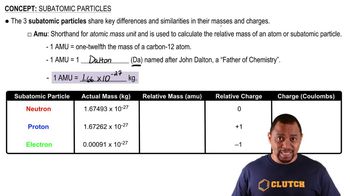
Subatomic particles are the fundamental constituents of atoms, which include protons, neutrons, and electrons. Protons and neutrons reside in the nucleus of an atom, while electrons orbit around the nucleus. Understanding these particles is essential for grasping atomic structure and the behavior of matter.
추천 영상:
가이드 코스
05:19
Subatomic Particles

Neutron

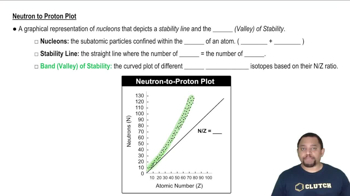
A neutron is a neutral subatomic particle found in the nucleus of an atom. It has no electric charge and a mass slightly greater than that of a proton. Neutrons play a crucial role in stabilizing the nucleus, as they help to offset the repulsive forces between positively charged protons.
추천 영상:
가이드 코스
01:38
Neutron-to-Proton Plot

Symbol Representation

In chemistry and physics, symbols are used to represent elements and subatomic particles for clarity and brevity. The symbol for a neutron is 'n' or sometimes 'n0' to indicate its neutral charge. Understanding these symbols is important for interpreting chemical equations and nuclear reactions.
추천 영상:
가이드 코스
03:17
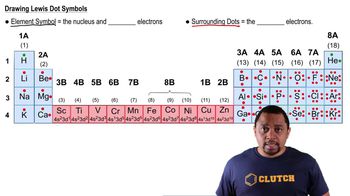
Lewis Dot Symbols