Ch.21 - Nuclear Chemistry
Brown - Chemistry: The Central Science 14th Edition
Brown14th EditionChemistry: The Central ScienceISBN: 9780134414232당신이 사용하는 게 아니라요?교과서 변경
21장, 문제 47

How much energy must be supplied to break a single aluminum-27 nucleus into separated protons and neutrons if an aluminum-27 atom has a mass of 26.9815386 amu? How much energy is required for 100.0 g of aluminum-27? (The mass of an electron is given on the inside back cover.)

검증된 단계별 안내
1
Step 1: First, we need to calculate the mass of the aluminum-27 nucleus. This can be done by subtracting the mass of 13 electrons (since aluminum-27 has 13 electrons) from the total mass of the aluminum-27 atom. The mass of an electron is given, so multiply this by 13 and subtract from the total mass of the atom.
Step 2: Next, we need to calculate the mass of 13 protons and 14 neutrons (since aluminum-27 has 13 protons and 14 neutrons). The mass of a proton is 1.007276 amu and the mass of a neutron is 1.008665 amu. Multiply these by the number of protons and neutrons respectively and add the results together.
Step 3: Now, we need to calculate the mass defect. This is done by subtracting the mass of the aluminum-27 nucleus (calculated in step 1) from the total mass of the protons and neutrons (calculated in step 2).
Step 4: Convert the mass defect from amu to kilograms by multiplying by 1.66053906660 x 10^-27 kg/amu.
Step 5: Finally, calculate the energy required to break the nucleus into separated protons and neutrons using Einstein's equation E=mc^2, where m is the mass defect in kilograms and c is the speed of light in meters per second (3.00 x 10^8 m/s). This will give the energy in joules. To find the energy required for 100.0 g of aluminum-27, multiply the energy for a single nucleus by the number of nuclei in 100.0 g of aluminum-27 (which can be found by dividing 100.0 g by the molar mass of aluminum-27 and then multiplying by Avogadro's number).

비슷한 문제에 대한 검증된 영상 답변:

이 영상 해법은 위 문제에 도움이 된다고 튜터들이 추천한 것입니다.
영상 길이:
10m

주요 개념

질문에 올바르게 답하기 위해 반드시 이해해야 하는 핵심 개념들은 다음과 같습니다.

Mass-Energy Equivalence

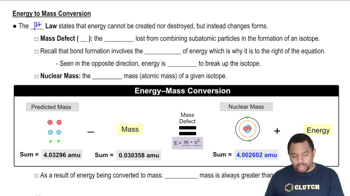
Mass-energy equivalence, expressed by Einstein's equation E=mc², states that mass can be converted into energy and vice versa. In nuclear reactions, the mass of the nucleus before and after the reaction can differ, and this mass difference (mass defect) is converted into energy. Understanding this principle is crucial for calculating the energy required to break apart a nucleus.
추천 영상:
가이드 코스
04:12
Energy to Mass Conversion

Binding Energy

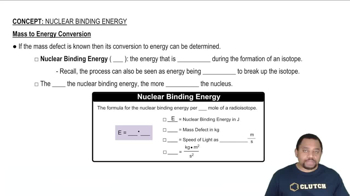
Binding energy is the energy required to separate a nucleus into its individual protons and neutrons. It is a measure of the stability of the nucleus; higher binding energy indicates a more stable nucleus. The binding energy can be calculated using the mass defect of the nucleus, which is the difference between the mass of the separate nucleons and the mass of the nucleus itself.
추천 영상:
가이드 코스
02:06
Nuclear Binding Energy

Molar Mass and Avogadro's Number

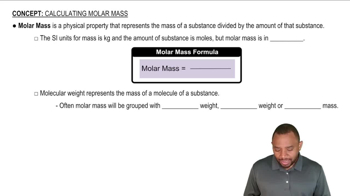
Molar mass is the mass of one mole of a substance, typically expressed in grams per mole. For aluminum-27, the molar mass is approximately 27 g/mol. Avogadro's number (6.022 x 10²³) allows us to convert between moles and the number of atoms or nuclei. This concept is essential for calculating the total energy required for a given mass of aluminum-27 by determining how many nuclei are present in that mass.
추천 영상:
가이드 코스
02:11
Molar Mass Concept