Ch.21 - Nuclear Chemistry
Brown - Chemistry: The Central Science 14th Edition
Brown14th EditionChemistry: The Central ScienceISBN: 9780134414232당신이 사용하는 게 아니라요?교과서 변경
21장, 문제 46

The thermite reaction, Fe2O31s2 + 2 Al1s2 ¡2 Fe1s2 + Al2O31s2, H = -851.5 kJ>mol, is one of the most exothermic reactions known. Because the heat released is sufficient to melt the iron product, the reaction is used to weld metal under the ocean. How much heat is released per mole of Al2O3 produced? How does this amount of thermal energy compare with the energy released when 2 mol of protons and 2 mol of neutrons combine to form 1 mol of alpha particles?

검증된 단계별 안내
1
Identify the given enthalpy change (ΔH) for the reaction, which is -851.5 kJ. This value represents the heat released when the reaction proceeds as written.
Note that the stoichiometry of the reaction shows that 1 mole of Al2O3 is produced per reaction cycle. Therefore, the heat released per mole of Al2O3 produced is directly given by the ΔH of the reaction.
Understand that the comparison with nuclear reactions, such as the combination of protons and neutrons to form alpha particles, involves different scales of energy. Nuclear reactions typically release much greater amounts of energy per mole than chemical reactions.
To compare the energies, you would need the specific ΔH value for the nuclear reaction mentioned. This typically involves looking up or calculating the energy released based on mass defects and conversion into energy using Einstein's equation E=mc^2.
Finally, compare the magnitude of the energy released in the thermite reaction to that of the nuclear reaction to understand the scale and applications of each type of reaction.

비슷한 문제에 대한 검증된 영상 답변:

이 영상 해법은 위 문제에 도움이 된다고 튜터들이 추천한 것입니다.
영상 길이:
5m

주요 개념

질문에 올바르게 답하기 위해 반드시 이해해야 하는 핵심 개념들은 다음과 같습니다.

Thermodynamics and Enthalpy

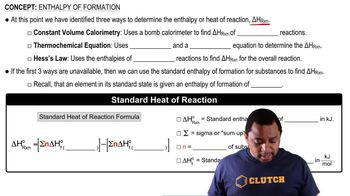
Thermodynamics is the study of energy transformations, and enthalpy (ΔH) is a key concept that measures the heat content of a system at constant pressure. In the thermite reaction, the negative ΔH value indicates that the reaction is exothermic, meaning it releases heat. Understanding how to interpret ΔH allows us to calculate the heat released per mole of products formed, such as Al2O3.
추천 영상:
가이드 코스
02:34
Enthalpy of Formation

Stoichiometry

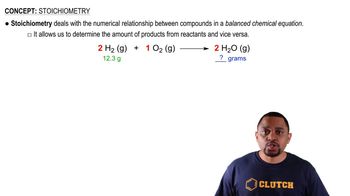
Stoichiometry involves the calculation of reactants and products in chemical reactions based on balanced equations. In the thermite reaction, the coefficients indicate the molar ratios of reactants and products. By applying stoichiometric principles, we can determine the amount of heat released per mole of Al2O3 produced by relating it to the total heat released in the reaction.
추천 영상:
가이드 코스
01:16
Stoichiometry Concept

Nuclear Reactions and Energy Release

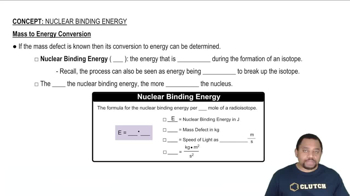
Nuclear reactions, such as the fusion of protons and neutrons to form alpha particles, release energy due to the conversion of mass into energy, as described by Einstein's equation E=mc². This energy release is typically much greater than that of chemical reactions. Comparing the energy released in the thermite reaction with that from nuclear fusion highlights the significant differences in energy scales between chemical and nuclear processes.
추천 영상:
가이드 코스
02:06
Nuclear Binding Energy