
Ch.21 - Nuclear Chemistry
Brown - Chemistry: The Central Science 14th Edition
Brown14th EditionChemistry: The Central ScienceISBN: 9780134414232당신이 사용하는 게 아니라요?교과서 변경
21장, 문제 38

How much time is required for a 6.25-mg sample of 51Cr to decay to 0.75 mg if it has a half-life of 27.8 days?

검증된 단계별 안내
1
Step 1: Understand the concept of half-life, which is the time required for half of a radioactive substance to decay. In this problem, the half-life of 51Cr is given as 27.8 days.
Step 2: Use the formula for exponential decay: \( N = N_0 \times (\frac{1}{2})^{\frac{t}{t_{1/2}}} \), where \( N \) is the remaining quantity, \( N_0 \) is the initial quantity, \( t \) is the time elapsed, and \( t_{1/2} \) is the half-life.
Step 3: Substitute the given values into the formula: \( 0.75 = 6.25 \times (\frac{1}{2})^{\frac{t}{27.8}} \).
Step 4: Solve for \( t \) by first dividing both sides by 6.25 to isolate the exponential term: \( (\frac{1}{2})^{\frac{t}{27.8}} = \frac{0.75}{6.25} \).
Step 5: Take the natural logarithm of both sides to solve for \( t \): \( \ln((\frac{1}{2})^{\frac{t}{27.8}}) = \ln(\frac{0.75}{6.25}) \), and use the property of logarithms to bring down the exponent: \( \frac{t}{27.8} \cdot \ln(\frac{1}{2}) = \ln(\frac{0.75}{6.25}) \). Solve for \( t \).

주요 개념

질문에 올바르게 답하기 위해 반드시 이해해야 하는 핵심 개념들은 다음과 같습니다.

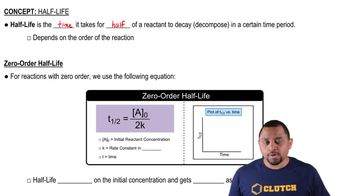
Half-life

Half-life is the time required for half of a sample of a radioactive substance to decay. It is a constant property of each radioactive isotope, indicating how quickly it transforms into a more stable form. In this question, the half-life of 51Cr is given as 27.8 days, which will be crucial for calculating the time needed for the sample to decay from 6.25 mg to 0.75 mg.
추천 영상:
가이드 코스
02:17
Zero-Order Half-life

Exponential Decay

Exponential decay describes the process by which a quantity decreases at a rate proportional to its current value. In radioactive decay, the amount of substance remaining decreases exponentially over time, which can be modeled mathematically. This concept is essential for understanding how the mass of 51Cr will reduce over successive half-lives until it reaches the desired amount.
추천 영상:

Decay Formula

The decay formula, often expressed as N(t) = N0 * (1/2)^(t/T), relates the remaining quantity of a substance (N(t)) to its initial quantity (N0), the time elapsed (t), and the half-life (T). This formula allows us to calculate the time required for a sample to decay to a specific amount, making it a key tool for solving the given problem regarding the decay of 51Cr.
추천 영상: