
Ch.21 - Nuclear Chemistry
Brown - Chemistry: The Central Science 14th Edition
Brown14th EditionChemistry: The Central ScienceISBN: 9780134414232당신이 사용하는 게 아니라요?교과서 변경
21장, 문제 22

One nuclide in each of these pairs is radioactive. Predict which is radioactive and which is stable: (a) 4020Ca and 4520Ca. Explain your choice in each case. (b) 12C and 14C. Explain your choice in each case. (c) lead-206 and thorium-230. Explain your choice in each case.

검증된 단계별 안내
1
Step 1: Understand the concept of nuclear stability. A nuclide's stability is influenced by the ratio of neutrons to protons (N/Z ratio) and the presence of magic numbers, which are numbers of nucleons that complete a shell within the nucleus.
Step 2: Analyze pair (a) 40_20Ca and 45_20Ca. Calculate the N/Z ratio for each nuclide. For 40_20Ca, the number of neutrons is 20, giving an N/Z ratio of 1. For 45_20Ca, the number of neutrons is 25, giving an N/Z ratio of 1.25. Compare these ratios to the ideal ratio for stability, which is close to 1 for lighter elements.
Step 3: Analyze pair (b) 12C and 14C. Calculate the N/Z ratio for each nuclide. For 12C, the number of neutrons is 6, giving an N/Z ratio of 1. For 14C, the number of neutrons is 8, giving an N/Z ratio of 1.33. Consider the stability of carbon isotopes and the fact that 14C is known to be radioactive.
Step 4: Analyze pair (c) lead-206 and thorium-230. Recognize that lead-206 is a stable isotope, often found as a product of radioactive decay chains, while thorium-230 is part of the decay series of uranium-238 and is radioactive.
Step 5: Conclude which nuclide in each pair is radioactive based on the N/Z ratio and known stability of isotopes. For pair (a), 45_20Ca is radioactive due to its higher N/Z ratio. For pair (b), 14C is radioactive as it is a known radioactive isotope. For pair (c), thorium-230 is radioactive as it is part of a decay series.

주요 개념

질문에 올바르게 답하기 위해 반드시 이해해야 하는 핵심 개념들은 다음과 같습니다.

Nuclear Stability

Nuclear stability refers to the ability of a nucleus to remain intact without undergoing radioactive decay. Stable nuclei have a balanced ratio of protons to neutrons, while unstable nuclei may have too many or too few neutrons, leading to decay. Understanding the stability of isotopes is crucial for predicting which nuclides are radioactive.
추천 영상:
가이드 코스
03:29
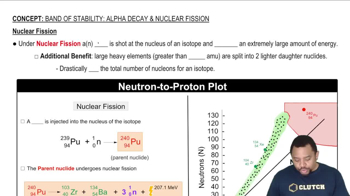
Band of Stability: Nuclear Fission

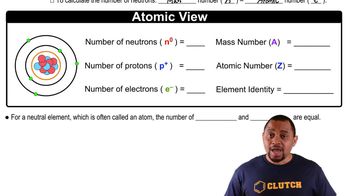
Isotopes

Isotopes are variants of a chemical element that have the same number of protons but different numbers of neutrons. This difference in neutron count can affect the stability of the nucleus. For example, carbon-12 is stable, while carbon-14 is radioactive due to its higher neutron count, which makes it prone to decay.
추천 영상:

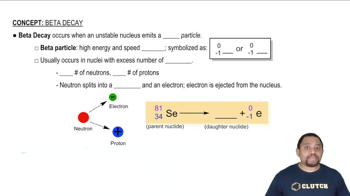
Decay Modes

Decay modes are the processes by which unstable nuclei release energy and particles to achieve stability. Common decay modes include alpha decay, beta decay, and gamma decay. Identifying the decay mode helps in understanding the nature of the radioactive nuclide and predicting its behavior over time.
추천 영상: