Ch.21 - Nuclear Chemistry
Brown - Chemistry: The Central Science 14th Edition
Brown14th EditionChemistry: The Central ScienceISBN: 9780134414232당신이 사용하는 게 아니라요?교과서 변경
21장, 문제 20a

Each of the following nuclei undergoes either beta decay or positron emission. Predict the type of emission for each: (a) tritium, 31H.

검증된 단계별 안내
1
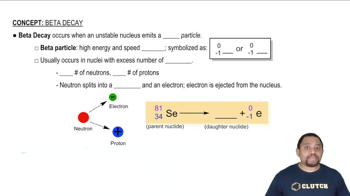
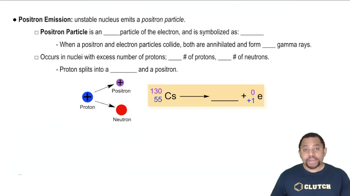
Step 1: Understand the types of decay. Beta decay occurs when a neutron in the nucleus of an atom decays into a proton and an electron (beta particle). The proton stays in the nucleus and the electron is emitted. Positron emission occurs when a proton in the nucleus decays into a neutron and a positron. The neutron stays in the nucleus and the positron is emitted.
Step 2: Look at the atomic number of the isotope. Tritium, 31H, has 1 proton and 2 neutrons.
Step 3: Consider the neutron to proton ratio. For light elements (atomic number less than 20), a 1:1 ratio of neutrons to protons is stable. Tritium has more neutrons than protons, so it is neutron-rich.
Step 4: Predict the type of decay. Neutron-rich isotopes undergo beta decay to increase the number of protons and decrease the number of neutrons, moving towards a more stable configuration.
Step 5: Therefore, tritium, 31H, undergoes beta decay.

비슷한 문제에 대한 검증된 영상 답변:

이 영상 해법은 위 문제에 도움이 된다고 튜터들이 추천한 것입니다.
영상 길이:
1m

주요 개념

질문에 올바르게 답하기 위해 반드시 이해해야 하는 핵심 개념들은 다음과 같습니다.

Beta Decay

Beta decay is a type of radioactive decay in which a nucleus emits a beta particle, which can be an electron (beta-minus decay) or a positron (beta-plus decay). In beta-minus decay, a neutron is converted into a proton, increasing the atomic number by one, while in beta-plus decay, a proton is converted into a neutron, decreasing the atomic number by one. This process helps unstable nuclei achieve a more stable configuration.
추천 영상:

Positron Emission

Positron emission, also known as beta-plus decay, occurs when a proton in a nucleus is transformed into a neutron, resulting in the emission of a positron (the antimatter counterpart of an electron). This process decreases the atomic number of the element by one while keeping the mass number unchanged. Positron emission is common in isotopes that are proton-rich and seek stability.
추천 영상:
가이드 코스
01:53
Positron Emission

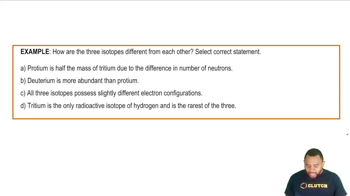
Tritium

Tritium is a radioactive isotope of hydrogen with one proton and two neutrons, represented as 3H. It is unstable and undergoes beta decay to achieve stability. In the case of tritium, it emits a beta particle (electron) as it decays into helium-3, which has one less neutron, thus illustrating the process of beta-minus decay.
추천 영상:
가이드 코스
01:18
Hydrogen Isotopes Example