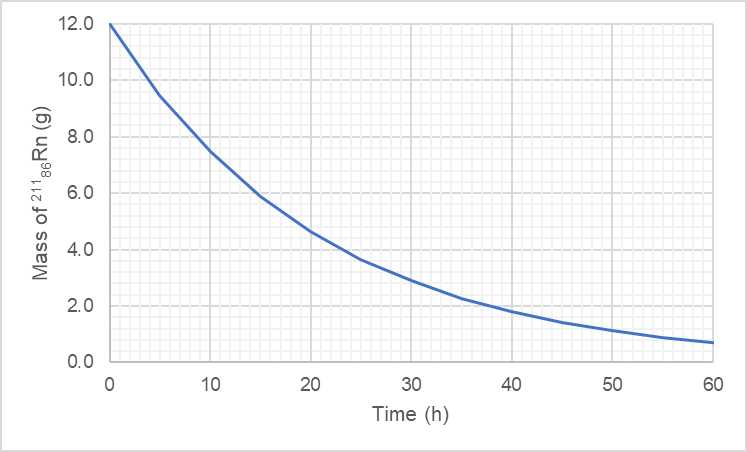
The accompanying graph illustrates the decay of 8842Mo, which decays via positron emission. (a) What is the halflife of the decay? [Section 21.4]
Ch.21 - Nuclear Chemistry
21장, 문제 6d
The accompanying graph illustrates the decay of 8842Mo, which decays via positron emission. (d) What is the product of the decay process? [Section 21.4]

검증된 단계별 안내1
Identify the initial isotope undergoing decay: ^{88}_{42}Mo.
Determine the type of decay: positron emission (β^+ decay).
Write the nuclear equation for positron emission: ^{88}_{42}Mo → ^{88}_{41}Nb + β^+.
Identify the product of the decay process: the new element formed is Niobium (Nb) with a mass number of 88 and an atomic number of 41.
Verify the conservation of mass and atomic numbers in the nuclear equation to ensure the correctness of the product.

비슷한 문제에 대한 검증된 영상 답변:
이 영상 해법은 위 문제에 도움이 된다고 튜터들이 추천한 것입니다.
영상 길이:
2m주요 개념
질문에 올바르게 답하기 위해 반드시 이해해야 하는 핵심 개념들은 다음과 같습니다.
Radioactive Decay
Radioactive decay is the process by which an unstable atomic nucleus loses energy by emitting radiation. This can occur through various modes, including alpha decay, beta decay, and positron emission. In the case of positron emission, a proton in the nucleus is transformed into a neutron, releasing a positron and a neutrino, which results in a decrease in the atomic number of the element.
추천 영상:
가이드 코스
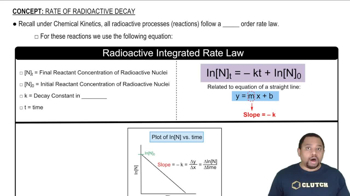
Rate of Radioactive Decay
Decay Products
The decay product is the new element or isotope formed as a result of radioactive decay. For example, when molybdenum-88 (
88
42Mo) undergoes positron emission, it transforms into a different element with a lower atomic number. Understanding the decay products is crucial for applications in nuclear chemistry, medicine, and radiometric dating.
추천 영상:
가이드 코스
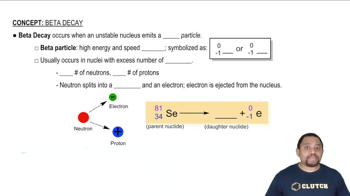
Beta Decay
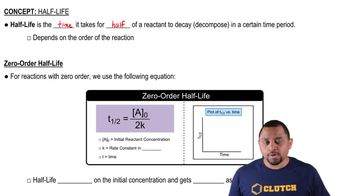
Half-Life
Half-life is the time required for half of the radioactive nuclei in a sample to decay. This concept is essential for predicting the behavior of radioactive substances over time. The graph provided illustrates the decay of radon-218, showing how the mass decreases exponentially, which is characteristic of half-life behavior in radioactive decay processes.
추천 영상:
가이드 코스
Zero-Order Half-life
관련 실천
교과서 질문
580
views
교과서 질문
All the stable isotopes of boron, carbon, nitrogen, oxygen, and fluorine are shown in the accompanying chart (in red), along with their radioactive isotopes with t1>2 7 1 min (in blue). (b) Which radioactive isotopes are most likely to decay by beta emission? [Sections 21.2, 21.4, and 21.5]
844
views
교과서 질문
The accompanying graph illustrates the decay of 8842Mo, which decays via positron emission. (c) What fraction of the original sample of 8842Mo remains after 12 min? [Section 21.4]
496
views
교과서 질문
The accompanying graph illustrates the decay of 8842Mo, which decays via positron emission. (b) What is the rate constant for the decay? [Section 21.4]
350
views