
Ch.21 - Nuclear Chemistry
Brown - Chemistry: The Central Science 14th Edition
Brown14th EditionChemistry: The Central ScienceISBN: 9780134414232당신이 사용하는 게 아니라요?교과서 변경
21장, 문제 25

Which of the following statements best explains why alpha emission is relatively common, but proton emission is extremely rare? (a) Alpha particles are very stable because of magic numbers of protons and neutrons. (b) Alpha particles occur in the nucleus. (c) Alpha particles are the nuclei of an inert gas. (d) An alpha particle has a higher charge than a proton.

검증된 단계별 안내
1
Step 1: Understand the nature of alpha particles. Alpha particles are helium nuclei, consisting of 2 protons and 2 neutrons, which makes them very stable due to the 'magic numbers' of protons and neutrons.
Step 2: Recognize the concept of 'magic numbers'. In nuclear physics, magic numbers refer to numbers of protons or neutrons that complete a shell within the nucleus, leading to extra stability.
Step 3: Compare the stability of alpha particles to protons. Alpha particles, being stable due to their composition, are more likely to be emitted from a nucleus than a single proton, which does not have the same inherent stability.
Step 4: Consider the role of nuclear forces. The strong nuclear force binds protons and neutrons in the nucleus. Alpha particles, with their balanced composition, are more favorably emitted than single protons, which would disrupt the nuclear balance.
Step 5: Evaluate the options. Option (a) highlights the stability of alpha particles due to magic numbers, which is a key reason for their common emission compared to the rarity of proton emission.

주요 개념

질문에 올바르게 답하기 위해 반드시 이해해야 하는 핵심 개념들은 다음과 같습니다.

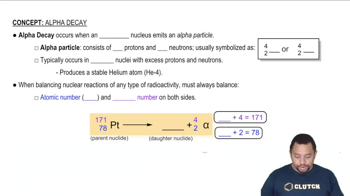
Alpha Emission

Alpha emission is a type of radioactive decay where an atomic nucleus emits an alpha particle, which consists of two protons and two neutrons. This process is common in heavy elements because the emission of an alpha particle helps the nucleus achieve a more stable configuration, often associated with 'magic numbers' of nucleons that confer additional stability.
추천 영상:

Proton Emission

Proton emission is a less common form of radioactive decay where a proton is ejected from the nucleus. This process is rare because it typically requires a nucleus to be in a highly unstable state, as removing a proton can significantly disrupt the balance of forces within the nucleus, making it less favorable compared to alpha emission.
추천 영상:
가이드 코스
02:14
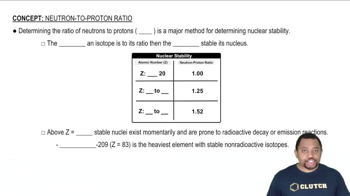
Neutron-Proton Ratio

Nuclear Stability

Nuclear stability is determined by the ratio of protons to neutrons and the overall binding energy of the nucleus. Nuclei with 'magic numbers' of protons and neutrons are particularly stable, which explains why alpha particles, which are composed of these stable configurations, are more commonly emitted than protons, which do not benefit from the same level of stability.
추천 영상:
가이드 코스
03:29
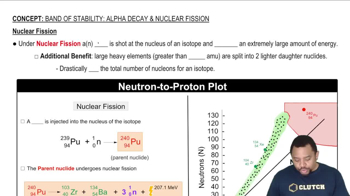
Band of Stability: Nuclear Fission