Ch.23 - Transition Metals and Coordination Chemistry
Brown - Chemistry: The Central Science 14th Edition
Brown14th EditionChemistry: The Central ScienceISBN: 9780134414232당신이 사용하는 게 아니라요?교과서 변경
23장, 문제 48

Complete the exercises below. a. A complex absorbs photons with an energy of 4.51 x 10⁻¹⁹ J. What is the wavelength of these photons? b. If this is the only place in the visible spectrum where the complex absorbs light, what color would you expect the complex to be?

검증된 단계별 안내
1
Step 1: Use the equation that relates energy and wavelength of a photon: \( E = \frac{hc}{\lambda} \), where \( E \) is the energy of the photon, \( h \) is Planck's constant \( 6.626 \times 10^{-34} \text{ J s} \), \( c \) is the speed of light \( 3.00 \times 10^8 \text{ m/s} \), and \( \lambda \) is the wavelength.
Step 2: Rearrange the equation to solve for wavelength \( \lambda \): \( \lambda = \frac{hc}{E} \).
Step 3: Substitute the given energy \( E = 4.51 \times 10^{-19} \text{ J} \), Planck's constant \( h = 6.626 \times 10^{-34} \text{ J s} \), and the speed of light \( c = 3.00 \times 10^8 \text{ m/s} \) into the equation to calculate \( \lambda \).
Step 4: Convert the calculated wavelength from meters to nanometers by multiplying by \( 1 \times 10^9 \text{ nm/m} \) to find the wavelength in the visible spectrum.
Step 5: Determine the color of the complex by identifying the complementary color of the absorbed wavelength. Use a color wheel or chart to find the color opposite to the absorbed wavelength in the visible spectrum.

주요 개념

질문에 올바르게 답하기 위해 반드시 이해해야 하는 핵심 개념들은 다음과 같습니다.

Photon Energy and Wavelength Relationship

The energy of a photon is inversely related to its wavelength, described by the equation E = hc/λ, where E is energy, h is Planck's constant, c is the speed of light, and λ is wavelength. This relationship allows us to calculate the wavelength of a photon when its energy is known, and vice versa.
추천 영상:
가이드 코스
00:31
Frequency-Wavelength Relationship

Visible Spectrum and Color Perception

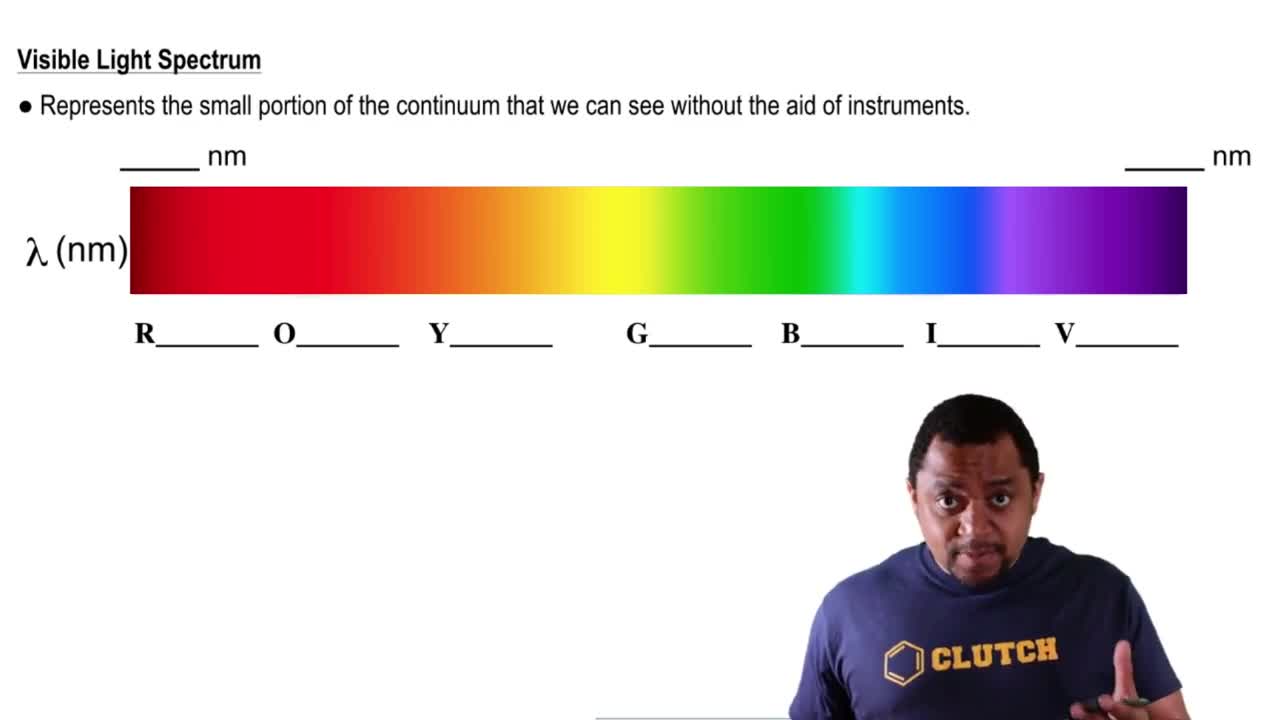
The visible spectrum is the portion of the electromagnetic spectrum that can be detected by the human eye, ranging from approximately 400 nm (violet) to 700 nm (red). The color perceived by an object is determined by the wavelengths of light it reflects; if a complex absorbs light at a specific wavelength, it will appear as the complementary color of that wavelength.
추천 영상:
가이드 코스
01:24
Visible Light Spectrum

Planck's Constant

Planck's constant (h) is a fundamental constant in quantum mechanics, valued at approximately 6.626 x 10⁻³⁴ J·s. It plays a crucial role in the quantization of energy levels and is essential for calculations involving photon energy and wavelength, linking the microscopic world of photons to macroscopic observations of light.
추천 영상:
가이드 코스
00:50
Photons and Planck's Constant