Ch.23 - Transition Metals and Coordination Chemistry
Brown - Chemistry: The Central Science 14th Edition
Brown14th EditionChemistry: The Central ScienceISBN: 9780134414232당신이 사용하는 게 아니라요?교과서 변경
23장, 문제 59

A classmate says, “A weak-field ligand usually means the complex is high spin.” Is your classmate correct? Explain.

검증된 단계별 안내
1
Understand the terms: A 'ligand' is a molecule or ion that binds to a central metal atom to form a coordination complex. The 'field strength' of a ligand refers to its ability to split the d-orbitals of the metal ion in a complex.
Recognize the relationship between field strength and electron pairing: Weak-field ligands cause smaller splitting of the d-orbitals in a metal complex compared to strong-field ligands. This smaller splitting may not be sufficient to overcome the electron pairing energy.
Define high spin and low spin complexes: In a high spin complex, electrons occupy higher energy d-orbitals to maximize unpaired electrons, due to insufficient splitting by the ligand. In a low spin complex, electrons pair up in the lower energy d-orbitals as the splitting is significant enough to overcome electron pairing energy.
Connect ligand field strength to spin state: With weak-field ligands, the splitting of d-orbitals is not large enough to promote electron pairing, leading to a high spin state where more unpaired electrons are present.
Conclude the accuracy of the statement: Your classmate is correct. A weak-field ligand usually results in a high spin complex because the small splitting of d-orbitals does not favor electron pairing, thus maximizing the number of unpaired electrons.

비슷한 문제에 대한 검증된 영상 답변:

이 영상 해법은 위 문제에 도움이 된다고 튜터들이 추천한 것입니다.
영상 길이:
5m
도움이 되었나요?

주요 개념

질문에 올바르게 답하기 위해 반드시 이해해야 하는 핵심 개념들은 다음과 같습니다.

Ligand Field Theory

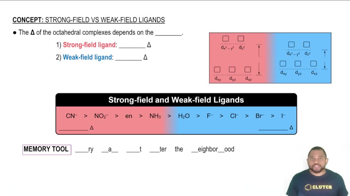
Ligand Field Theory explains how the presence of ligands around a central metal ion affects the energy levels of the d-orbitals. In this theory, ligands can be classified as strong or weak field based on their ability to split the d-orbital energies. Strong field ligands cause a large splitting, leading to low spin complexes, while weak field ligands result in smaller splitting, often leading to high spin complexes.
추천 영상:
가이드 코스
02:40
Strong-Field Ligands result in a large Δ and Weak-Field Ligands result in a small Δ.

Spin State of Complexes

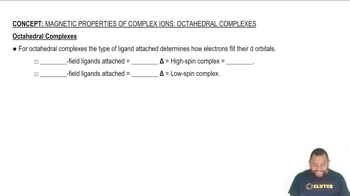
The spin state of a complex refers to the arrangement of electrons in the d-orbitals, which can be either high spin or low spin. High spin complexes have unpaired electrons in higher energy orbitals due to smaller splitting, while low spin complexes have paired electrons in lower energy orbitals due to larger splitting. The spin state significantly influences the magnetic properties and reactivity of the complex.
추천 영상:
가이드 코스
01:28
For octahedral complexes, Weak-Field Ligands create High-spin complexes and Strong-Field Ligands create Low-spin complexes.

Crystal Field Splitting Energy (Δ)

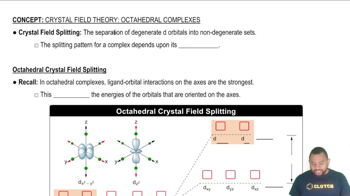
Crystal Field Splitting Energy (Δ) is the energy difference between the split d-orbitals in a transition metal complex. The magnitude of Δ is influenced by the nature of the ligands; weak field ligands produce a small Δ, favoring high spin configurations, while strong field ligands produce a large Δ, favoring low spin configurations. Understanding Δ is crucial for predicting the electronic structure and properties of coordination compounds.
추천 영상:
가이드 코스
03:04
The crystal field splitting pattern for octahedral complexes has the d orbitals on or along the axes as having the higher energy.