Ch.23 - Transition Metals and Coordination Chemistry
Brown - Chemistry: The Central Science 14th Edition
Brown14th EditionChemistry: The Central ScienceISBN: 9780134414232당신이 사용하는 게 아니라요?교과서 변경
23장, 문제 58

Complete the exercises below. Give the number of (valence) d electrons associated with the central metal ion in each of the following complexes: a. K₃[Fe(CN)₆] b. [Mn(H₂O)₆](NO₃)₂ c. Na[Ag(CN)₂] d. [Cr(NH₃)₄Br₂]ClO₄ e. [Sr(EDTA)]²⁻

검증된 단계별 안내
1
Identify the oxidation state of the central metal ion in each complex by considering the charges of the ligands and the overall charge of the complex.
Determine the electron configuration of the neutral metal atom, focusing on the d electrons.
Subtract the number of electrons corresponding to the oxidation state from the total number of d electrons in the neutral atom to find the number of valence d electrons in the metal ion.
For each complex, apply the above steps to calculate the number of valence d electrons for the central metal ion.
Verify your results by ensuring the sum of the charges of the metal ion and the ligands equals the overall charge of the complex.

주요 개념

질문에 올바르게 답하기 위해 반드시 이해해야 하는 핵심 개념들은 다음과 같습니다.

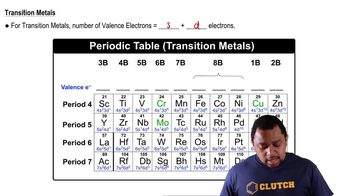
Valence Electrons

Valence electrons are the outermost electrons of an atom that are involved in forming bonds. For transition metals, these include the s and d electrons in the outermost shell. Understanding the number of valence electrons is crucial for determining the oxidation state of the metal ion in coordination complexes.
추천 영상:
가이드 코스
02:12
Transition Metals Valence Electrons

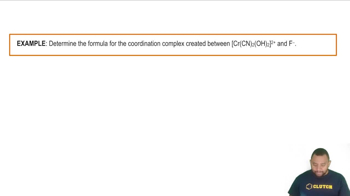
Coordination Complexes

Coordination complexes consist of a central metal atom or ion bonded to surrounding molecules or ions called ligands. The nature of these ligands, whether they are neutral or charged, affects the overall charge of the complex and the electron count of the central metal. Identifying the ligands and their charges is essential for calculating the d electron count.
추천 영상:
가이드 코스
00:43
Coordination Complexes Example

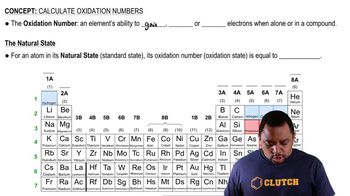
Oxidation State

The oxidation state of a metal ion in a complex indicates the charge it carries, which influences the number of d electrons. To find the oxidation state, one must consider the charges of the ligands and the overall charge of the complex. This is vital for determining how many d electrons are present in the metal ion, as it directly affects its electronic configuration.
추천 영상:
가이드 코스
02:42
Oxidation Numbers