Complete the exercises below. For each of the following metals, write the electronic configuration of the atom and its 3+ ion: c. Co. Draw the crystal-field energy-level diagram for the d orbitals of an octahedral complex, and show the placement of the d electrons for each 3+ ion, assuming a weak-field complex. How many unpaired electrons are there in each case?
검증된 단계별 안내
1
Step 1: Determine the atomic number of cobalt (Co), which is 27. This tells us that a neutral cobalt atom has 27 electrons.
Step 2: Write the electronic configuration for a neutral cobalt atom. Start by filling the lower energy orbitals first: 1s^2 2s^2 2p^6 3s^2 3p^6 4s^2 3d^7.
Step 3: To find the electronic configuration of the Co^{3+} ion, remove three electrons from the neutral atom's configuration. Electrons are removed first from the 4s orbital and then from the 3d orbital: Co^{3+} is 1s^2 2s^2 2p^6 3s^2 3p^6 3d^6.
Step 4: Draw the crystal-field energy-level diagram for the d orbitals in an octahedral complex. In a weak-field complex, the five d orbitals split into two sets: t_{2g} (lower energy) and e_g (higher energy).
Step 5: Place the six d electrons of Co^{3+} in the t_{2g} and e_g orbitals according to Hund's rule and the weak-field assumption. Count the number of unpaired electrons in the configuration.
주요 개념
질문에 올바르게 답하기 위해 반드시 이해해야 하는 핵심 개념들은 다음과 같습니다.
Electronic Configuration
Electronic configuration describes the distribution of electrons in an atom's orbitals. For cobalt (Co), which has an atomic number of 27, the ground state electronic configuration is [Ar] 3d7 4s2. When cobalt forms a 3+ ion, it loses three electrons, typically from the 4s and 3d orbitals, resulting in the configuration [Ar] 3d6.
Crystal Field Theory (CFT) explains how the arrangement of ligands around a central metal ion affects the energy levels of its d orbitals. In an octahedral complex, the five d orbitals split into two energy levels: the lower-energy t2g (dxy, dyz, dzx) and the higher-energy eg (dx2-y2, dz2) orbitals. The extent of this splitting depends on the strength of the ligands, which can be classified as strong or weak field.
The study of ligand-metal interactions helped to form Ligand Field Theory which combines CFT with MO Theory.
Unpaired Electrons and Magnetic Properties
The number of unpaired electrons in an atom or ion determines its magnetic properties. In the case of the Co3+ ion with a 3d6 configuration in a weak-field octahedral complex, the electrons will occupy the t2g orbitals first, leading to four unpaired electrons. This results in a paramagnetic behavior, as unpaired electrons contribute to the overall magnetic moment of the ion.


 검증된 단계별 안내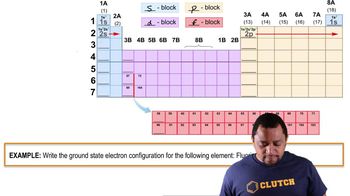
 01:33
01:33