Ch.23 - Transition Metals and Coordination Chemistry
Brown - Chemistry: The Central Science 14th Edition
Brown14th EditionChemistry: The Central ScienceISBN: 9780134414232당신이 사용하는 게 아니라요?교과서 변경
23장, 문제 89

Complete the exercises below. Generally speaking, for a given metal and ligand, the stability of a coordination compound is greater for the metal in the +3 oxidation state rather than in the +2 oxidation state (for metals that form stable +3 ions in the first place). Suggest an explanation, keeping in mind the Lewis acid–base nature of the metal–ligand bond.

검증된 단계별 안내
1
Step 1: Understand the nature of the metal-ligand bond. Coordination compounds involve metal ions (Lewis acids) and ligands (Lewis bases). The metal ion accepts electron pairs from the ligands to form coordinate covalent bonds.
Step 2: Consider the oxidation states of the metal. A metal in a +3 oxidation state has a higher positive charge than in a +2 oxidation state, which affects its ability to attract and bind ligands.
Step 3: Analyze the effect of charge on Lewis acidity. A higher positive charge on the metal ion increases its Lewis acidity, making it a stronger electron pair acceptor. This enhances the metal's ability to form stable bonds with ligands.
Step 4: Evaluate the stability of the coordination compound. The increased Lewis acidity of the metal in the +3 oxidation state leads to stronger metal-ligand interactions, resulting in a more stable coordination compound.
Step 5: Conclude with the relationship between oxidation state and stability. The greater stability of coordination compounds with metals in the +3 oxidation state is due to the stronger metal-ligand bonds formed as a result of the increased Lewis acidity of the metal ion.

주요 개념

질문에 올바르게 답하기 위해 반드시 이해해야 하는 핵심 개념들은 다음과 같습니다.

Oxidation States

Oxidation states indicate the degree of oxidation of an atom in a compound. In coordination chemistry, metals can exist in various oxidation states, with +2 and +3 being common for transition metals. The +3 oxidation state typically has a higher positive charge, which can lead to stronger interactions with ligands due to increased electrostatic attraction.
추천 영상:
가이드 코스
02:42
Oxidation Numbers

Lewis Acid-Base Theory

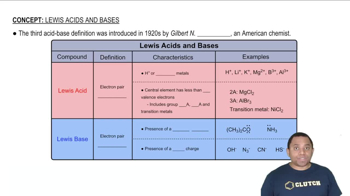
Lewis acid-base theory defines acids as electron pair acceptors and bases as electron pair donors. In the context of coordination compounds, the metal ion acts as a Lewis acid, while the ligands function as Lewis bases. The stronger the Lewis acid (higher oxidation state), the more effectively it can stabilize the coordination complex through stronger metal-ligand interactions.
추천 영상:
가이드 코스
05:04
Lewis Acids and Bases

Coordination Complex Stability

The stability of coordination complexes is influenced by factors such as the charge of the metal ion, the nature of the ligands, and the overall geometry of the complex. Generally, complexes with metal ions in higher oxidation states exhibit greater stability due to stronger metal-ligand bonds, which arise from enhanced electrostatic interactions and covalent character in the bonding.
추천 영상:
가이드 코스
00:43
Coordination Complexes Example