Ch.23 - Transition Metals and Coordination Chemistry
Brown - Chemistry: The Central Science 14th Edition
Brown14th EditionChemistry: The Central ScienceISBN: 9780134414232당신이 사용하는 게 아니라요?교과서 변경
23장, 문제 88

Complete the exercises below. When Alfred Werner was developing the field of coordination chemistry, it was argued by some that the optical activity he observed in the chiral complexes he had prepared was due to the presence of carbon atoms in the molecule. To disprove this argument, Werner synthesized a chiral complex of cobalt that had no carbon atoms in it, and he was able to resolve it into its enantiomers. Design a cobalt(III) complex that would be chiral if it could be synthesized and that contains no carbon atoms. (It may not be possible to synthesize the complex you design, but we will not worry about that for now.)

검증된 단계별 안내
1
Step 1: Understand the concept of chirality in coordination complexes. Chirality occurs when a molecule or ion cannot be superimposed on its mirror image, similar to left and right hands.
Step 2: Recognize that for a coordination complex to be chiral, it must lack a plane of symmetry. This often involves having a specific arrangement of ligands around the central metal ion.
Step 3: Consider the coordination number and geometry of cobalt(III) complexes. Cobalt(III) typically forms octahedral complexes with a coordination number of 6.
Step 4: Select ligands that do not contain carbon atoms. Common non-carbon ligands include halides (e.g., Cl⁻, Br⁻), oxides (e.g., O²⁻), and other anions like NO₂⁻ or NH₃.
Step 5: Arrange the selected ligands around the cobalt(III) ion in a way that creates a chiral arrangement. For example, use a combination of different ligands in a cis or trans configuration to achieve chirality.

주요 개념

질문에 올바르게 답하기 위해 반드시 이해해야 하는 핵심 개념들은 다음과 같습니다.

Coordination Chemistry

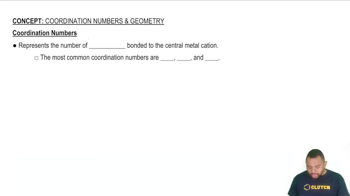
Coordination chemistry is the study of coordination compounds, which consist of a central metal atom bonded to surrounding molecules or ions called ligands. These complexes can exhibit various geometries and properties, influencing their reactivity and interactions. Understanding the nature of these bonds and the arrangement of ligands is crucial for predicting the behavior of metal complexes, including their chirality.
추천 영상:
가이드 코스
00:27
Coordination Numbers

Chirality and Enantiomers

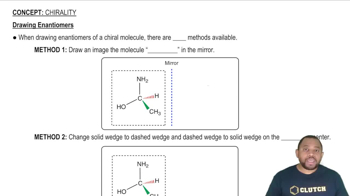
Chirality refers to the property of a molecule that makes it non-superimposable on its mirror image, much like left and right hands. Molecules that exhibit chirality can exist as pairs of enantiomers, which have identical physical properties but differ in their interaction with polarized light and biological systems. The presence of chiral centers, often involving asymmetric arrangements of ligands around a central atom, is essential for the formation of these enantiomers.
추천 영상:
가이드 코스
02:33
Drawing Enantiomers

Cobalt(III) Complexes

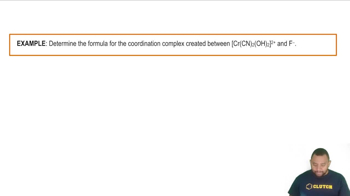
Cobalt(III) complexes are coordination compounds where cobalt is in the +3 oxidation state, typically forming octahedral geometries with six ligands. The choice of ligands and their spatial arrangement can lead to the formation of chiral complexes. Designing a chiral cobalt(III) complex without carbon atoms requires careful selection of ligands that can create an asymmetric environment around the cobalt center, thus enabling the potential for chirality.
추천 영상:
가이드 코스
00:43
Coordination Complexes Example