
Ch.23 - Transition Metals and Coordination Chemistry
Brown - Chemistry: The Central Science 14th Edition
Brown14th EditionChemistry: The Central ScienceISBN: 9780134414232당신이 사용하는 게 아니라요?교과서 변경
23장, 문제 11

Complete the exercises below. The lanthanide contraction explains which of the following periodic trends? a. The atomic radii of the transition metals first decrease and then increase when moving horizontally across each period. b. When forming ions, the period 4 transition metals lose their 4s electrons before their 3d electrons. c. The radii of the period 5 transition metals (Y–Cd) are very similar to the radii of the period 6 transition metals (Lu–Hg).

검증된 단계별 안내
1
Step 1: Understand the concept of lanthanide contraction. The lanthanide contraction refers to the phenomenon where the atomic radii of the lanthanide series elements decrease progressively with increasing atomic number, despite having similar electron configurations.
Step 2: Analyze how lanthanide contraction affects periodic trends. The contraction is due to poor shielding of the nuclear charge by the f-electrons, leading to a stronger attraction between the nucleus and the outer electrons.
Step 3: Evaluate option (a). Consider how the atomic radii of transition metals change across a period. This trend is more related to the filling of d-orbitals and not directly explained by lanthanide contraction.
Step 4: Evaluate option (b). Consider the electron configuration of period 4 transition metals and how they lose electrons. This behavior is due to energy considerations of 4s and 3d orbitals, not lanthanide contraction.
Step 5: Evaluate option (c). Compare the radii of period 5 and period 6 transition metals. The lanthanide contraction causes the radii of period 6 transition metals to be similar to those of period 5, as the contraction offsets the expected increase in size.

주요 개념

질문에 올바르게 답하기 위해 반드시 이해해야 하는 핵심 개념들은 다음과 같습니다.

Lanthanide Contraction

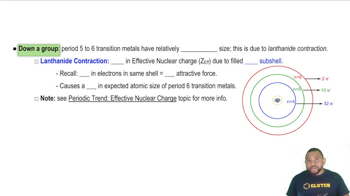
The lanthanide contraction refers to the gradual decrease in atomic and ionic radii of the lanthanide series elements due to the poor shielding effect of the f-electrons. As the atomic number increases, the effective nuclear charge felt by the outer electrons increases, leading to a stronger attraction and smaller radii. This phenomenon affects the properties of elements in subsequent periods, particularly transition metals.
추천 영상:
가이드 코스
02:30
Lanthanide Contraction

Periodic Trends in Atomic Radii

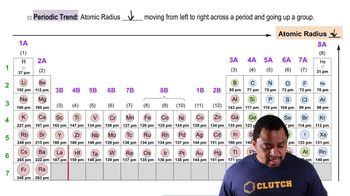
Periodic trends in atomic radii describe how the size of atoms changes across periods and down groups in the periodic table. Generally, atomic radii decrease from left to right across a period due to increased nuclear charge, which pulls electrons closer to the nucleus. Conversely, atomic radii increase down a group as additional electron shells are added, increasing the distance between the nucleus and the outermost electrons.
추천 영상:
가이드 코스
01:42
Atomic Radius Trends

Electron Configuration and Ionization

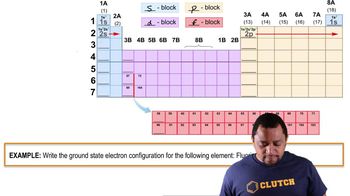
Electron configuration refers to the distribution of electrons in an atom's orbitals. In transition metals, the 4s orbital is filled before the 3d orbital, but when forming cations, the 4s electrons are lost first due to their higher energy level. This behavior is crucial for understanding the chemical properties and reactivity of transition metals, as it influences their oxidation states and bonding characteristics.
추천 영상:
가이드 코스
01:33
Electron Configuration Example