
Ch.23 - Transition Metals and Coordination Chemistry
Brown - Chemistry: The Central Science 14th Edition
Brown14th EditionChemistry: The Central ScienceISBN: 9780134414232당신이 사용하는 게 아니라요?교과서 변경
23장, 문제 9

In the linear crystal-field shown here, the negative charges are on the z-axis. Using Figure 23.28 as a guide, predict which of the following choices most accurately describes the splitting of the d orbitals in a linear crystal-field? [Find more in Section 23.6.]                                                                                                                                                

검증된 단계별 안내
1
Understand the geometry of the crystal field: In a linear crystal-field, the ligands are aligned along the z-axis, directly influencing the d orbitals along this axis.
Identify the d orbitals affected: The d orbitals that will be most affected are those that have lobes pointing along the z-axis, namely the \(d_{z^2}\) orbital.
Consider the effect on other d orbitals: The \(d_{x^2-y^2}\), \(d_{xy}\), \(d_{xz}\), and \(d_{yz}\) orbitals will be less affected as their lobes do not point directly along the z-axis.
Predict the splitting pattern: The \(d_{z^2}\) orbital will experience a different energy shift compared to the other four d orbitals due to its direct alignment along the z-axis.
Conclude the splitting: In a linear crystal-field, typically the \(d_{z^2}\) orbital will have a different energy compared to the other four (\(d_{x^2-y^2}\), \(d_{xy}\), \(d_{xz}\), and \(d_{yz}\)) which might remain degenerate or split further depending on the specific environment and ligand characteristics.

비슷한 문제에 대한 검증된 영상 답변:

이 영상 해법은 위 문제에 도움이 된다고 튜터들이 추천한 것입니다.
영상 길이:
4m

주요 개념

질문에 올바르게 답하기 위해 반드시 이해해야 하는 핵심 개념들은 다음과 같습니다.

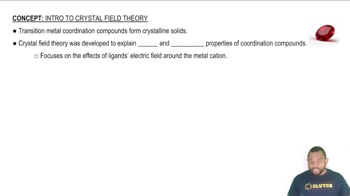
Crystal Field Theory

Crystal Field Theory (CFT) explains how the arrangement of ligands around a central metal ion affects the energy levels of the d orbitals. In a crystal field, the presence of negative charges from ligands can cause the d orbitals to split into different energy levels, depending on the geometry of the arrangement. This theory is crucial for understanding the electronic structure and color properties of transition metal complexes.
추천 영상:
가이드 코스
01:18
The study of ligand-metal interactions helped to form Ligand Field Theory which combines CFT with MO Theory.

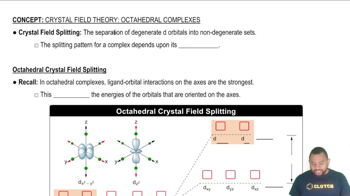
Orbital Splitting in Linear Fields

In a linear crystal field, the d orbitals split into two distinct energy levels due to the orientation of the ligands along the z-axis. Specifically, the d_{z^2} orbital experiences a higher energy due to direct interaction with the ligands, while the d_{x^2-y^2} orbital is also affected but to a lesser extent. Understanding this splitting is essential for predicting the electronic transitions and magnetic properties of the complex.
추천 영상:
가이드 코스
03:04
The crystal field splitting pattern for octahedral complexes has the d orbitals on or along the axes as having the higher energy.

Ligand Field Strength

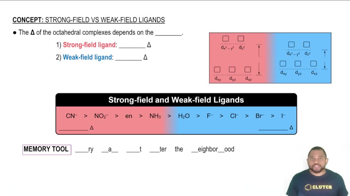
Ligand field strength refers to the ability of ligands to influence the energy levels of d orbitals in a metal complex. Strong field ligands cause greater splitting of the d orbitals, leading to different electronic configurations and properties compared to weak field ligands. This concept is vital for predicting the stability, color, and reactivity of transition metal complexes in various environments.
추천 영상:
가이드 코스
02:40
Strong-Field Ligands result in a large Δ and Weak-Field Ligands result in a small Δ.