
Ch.23 - Transition Metals and Coordination Chemistry
Brown - Chemistry: The Central Science 14th Edition
Brown14th EditionChemistry: The Central ScienceISBN: 9780134414232당신이 사용하는 게 아니라요?교과서 변경
23장, 문제 73

The molecule dimethylphosphinoethane [(CH3)2PCH2CH2P(CH3)2, which is abbreviated dmpe] is used as a ligand for some complexes that serve as catalysts. A complex that contains this ligand is Mo(CO)4(dmpe) .
a. Draw the Lewis structure for dmpe, and compare it with ethylenediamine as a coordinating ligand.
b. What is the oxidation state of Mo in Na2[Mo(CN)2(CO)2(dmpe)] ?
c. Sketch the structure of the [Mo(CN)2(CO)2(dmpe)]2- ion, including all the possible isomers.

검증된 단계별 안내
1
Step 1: To draw the Lewis structure for dmpe, start by counting the total number of valence electrons. Each carbon atom has 4 valence electrons, each hydrogen atom has 1, each phosphorus atom has 5, and each methyl group (CH3) has 8. Add these up to get the total number of valence electrons.
Step 2: Draw the skeletal structure of dmpe. The phosphorus atoms are bonded to the carbon atoms, and each carbon atom is also bonded to two hydrogen atoms. Each phosphorus atom is also bonded to two methyl groups.
Step 3: Distribute the remaining electrons as lone pairs on the atoms, starting with the outer atoms first. Each atom should have an octet of electrons (except hydrogen, which can only have 2).
Step 4: To find the oxidation state of Mo in Na2[Mo(CN)2(CO)2(dmpe)], start by assigning oxidation states to the known atoms. Sodium is +1, carbon in CN- is +2, nitrogen in CN- is -3, carbon in CO is +2, and oxygen in CO is -2. The total charge of the complex is -2.
Step 5: To sketch the structure of the [Mo(CN)2(CO)2(dmpe)]2- ion, start by drawing Mo at the center. Then, draw two CN- ligands, two CO ligands, and one dmpe ligand attached to the Mo atom. The CN- and CO ligands can be arranged in different ways around the Mo atom to create different isomers.

비슷한 문제에 대한 검증된 영상 답변:

이 영상 해법은 위 문제에 도움이 된다고 튜터들이 추천한 것입니다.
영상 길이:
7m
도움이 되었나요?

주요 개념

질문에 올바르게 답하기 위해 반드시 이해해야 하는 핵심 개념들은 다음과 같습니다.

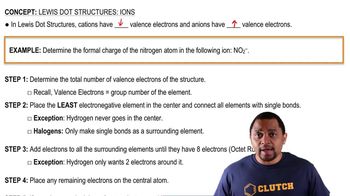
Lewis Structures

Lewis structures are diagrams that represent the bonding between atoms in a molecule and the lone pairs of electrons that may exist. They help visualize the arrangement of electrons and the connectivity of atoms, which is crucial for understanding molecular geometry and reactivity. In the context of ligands like dimethylphosphinoethane, drawing the Lewis structure allows for the identification of donor atoms that can coordinate with metal centers.
추천 영상:
가이드 코스
04:28
Lewis Dot Structures: Ions

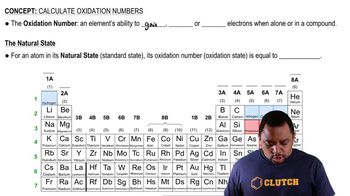
Oxidation States

The oxidation state of an element in a compound indicates the degree of oxidation (loss of electrons) of that element. It is essential for determining the electron transfer processes in redox reactions and for understanding the coordination chemistry of metal complexes. In the case of the complex Na2[Mo(CN)2(CO)2(dmpe)], calculating the oxidation state of molybdenum (Mo) involves considering the charges of the ligands and the overall charge of the complex.
추천 영상:
가이드 코스
02:42
Oxidation Numbers

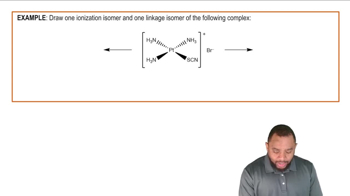
Isomerism in Coordination Compounds

Isomerism in coordination compounds refers to the existence of compounds with the same formula but different arrangements of atoms or ligands. This can include structural isomers, where the connectivity differs, and stereoisomers, where the spatial arrangement varies. Understanding isomerism is crucial for predicting the properties and reactivity of complexes like [Mo(CN)2(CO)2(dmpe)]2-, as different isomers can exhibit distinct chemical behaviors.
추천 영상:
가이드 코스
2:14
Isomerism in Coordination Complexes Example