
Ch.23 - Transition Metals and Coordination Chemistry
Brown - Chemistry: The Central Science 14th Edition
Brown14th EditionChemistry: The Central ScienceISBN: 9780134414232당신이 사용하는 게 아니라요?교과서 변경
23장, 문제 76

Complete the exercises below. Which transition metal atom is present in each of the following biologically important molecules: a. hemoglobin, b. chlorophylls, c. siderophores, d. hemocyanin?

검증된 단계별 안내
1
Identify the transition metal in hemoglobin: Hemoglobin is a protein in red blood cells responsible for oxygen transport. It contains a heme group, which is a porphyrin ring complexed with a specific transition metal.
Determine the transition metal in chlorophylls: Chlorophylls are pigments found in plants and are crucial for photosynthesis. They contain a porphyrin ring similar to heme, but with a different central metal atom.
Identify the transition metal in siderophores: Siderophores are molecules that bind and transport iron in microorganisms. They are not proteins but are small, high-affinity iron-chelating compounds.
Determine the transition metal in hemocyanin: Hemocyanin is a protein found in the blood of some invertebrates, functioning similarly to hemoglobin but with a different metal center.
Summarize the transition metals: For each molecule, identify the specific transition metal based on the biological function and structure of the molecule.

주요 개념

질문에 올바르게 답하기 위해 반드시 이해해야 하는 핵심 개념들은 다음과 같습니다.

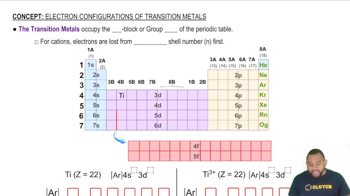
Transition Metals

Transition metals are elements found in the d-block of the periodic table, characterized by their ability to form variable oxidation states and complex ions. They play crucial roles in biological systems due to their ability to participate in redox reactions, which are essential for processes like oxygen transport and electron transfer.
추천 영상:
가이드 코스
03:12
Transition Metals

Biologically Important Molecules

Biologically important molecules are compounds that play vital roles in the functioning of living organisms. Examples include hemoglobin, which carries oxygen in the blood, chlorophyll, which is involved in photosynthesis, and siderophores, which are used by bacteria to scavenge iron from their environment. Understanding these molecules helps in grasping their significance in biological processes.
추천 영상:
가이드 코스
02:38
Heteronuclear Diatomic Molecules

Metal Ions in Biological Systems

Metal ions, particularly transition metals, are integral to the structure and function of many biological molecules. For instance, iron in hemoglobin binds oxygen, while magnesium in chlorophyll is essential for capturing light energy. The specific metal ion present in each molecule often determines its biological function and reactivity.
추천 영상: