
Ch.23 - Transition Metals and Coordination Chemistry
Brown - Chemistry: The Central Science 14th Edition
Brown14th EditionChemistry: The Central ScienceISBN: 9780134414232당신이 사용하는 게 아니라요?교과서 변경
23장, 문제 4

Four-coordinate metals can have either a tetrahedral or a square-planar geometry; both possibilities are shown here for [PtCl2(NH3)2].
a. What is the name of this molecule?
b. Would the tetrahedral molecule have a geometric isomer?
c. Would the tetrahedral molecule be diamagnetic or paramagnetic?
d. Would the square-planar molecule have a geometric isomer?

검증된 단계별 안내
1
Identify the components of the complex [PtCl2(NH3)2]. Pt is platinum, Cl is chloride, and NH3 is ammonia.
Determine the oxidation state of platinum in the complex. Since each Cl is -1 and each NH3 is neutral, the overall charge of the complex is 0, which helps in determining the oxidation state of Pt.
Use the oxidation state of Pt and the known ligands to predict the geometry of the complex. Platinum complexes with a +2 oxidation state can adopt either tetrahedral or square-planar geometries.
Analyze the possibility of geometric isomers for both tetrahedral and square-planar geometries. Geometric isomers occur when there are different possible arrangements of ligands around the central metal atom that are not interconvertible by rotation but only by breaking and reforming bonds.
Consider the magnetic properties based on the electron configuration of the metal center. If all the d-orbitals are paired, the complex is diamagnetic; if unpaired electrons are present, it is paramagnetic.

비슷한 문제에 대한 검증된 영상 답변:

이 영상 해법은 위 문제에 도움이 된다고 튜터들이 추천한 것입니다.
영상 길이:
11m
도움이 되었나요?

주요 개념

질문에 올바르게 답하기 위해 반드시 이해해야 하는 핵심 개념들은 다음과 같습니다.

Coordination Geometry

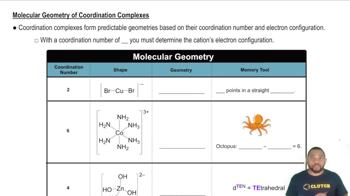
Coordination geometry refers to the spatial arrangement of ligands around a central metal atom in a coordination complex. In the case of four-coordinate metals, the two common geometries are tetrahedral and square-planar. The geometry affects the properties of the complex, including its reactivity and stability, and is determined by factors such as ligand size, charge, and electronic effects.
추천 영상:
가이드 코스
02:40
Molecular Geometry of Coordination Complexes

Geometric Isomerism

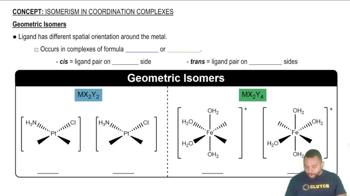
Geometric isomerism occurs when molecules with the same molecular formula have different spatial arrangements of atoms. In coordination complexes, this can lead to distinct isomers, such as cis and trans forms in square-planar complexes. Tetrahedral complexes typically do not exhibit geometric isomerism due to their symmetrical arrangement, while square-planar complexes can have geometric isomers based on the relative positions of the ligands.
추천 영상:
가이드 코스
02:02
Geometric Isomers

Magnetism in Coordination Complexes

The magnetic properties of coordination complexes, such as being diamagnetic or paramagnetic, depend on the presence of unpaired electrons in the metal's d-orbitals. Diamagnetic complexes have all electrons paired and are not attracted to a magnetic field, while paramagnetic complexes contain unpaired electrons and are attracted to magnetic fields. The geometry and ligand field strength influence the electron configuration and, consequently, the magnetic behavior of the complex.
추천 영상:
가이드 코스
00:43
Coordination Complexes Example