Ch.3 - Chemical Reactions and Reaction Stoichiometry
Brown - Chemistry: The Central Science 14th Edition
Brown14th EditionChemistry: The Central ScienceISBN: 9780134414232당신이 사용하는 게 아니라요?교과서 변경
3장, 문제 29a

(a) Write 'true' or 'false' for each statement. (a) A mole of horses contain a mole of horse legs.

검증된 단계별 안내
1
Step 1: Understand the concept of a mole. In chemistry, a mole is a unit of measurement used to express amounts of a chemical substance. It is defined as exactly 6.02214076×10^23 particles, which may be atoms, molecules, ions, or electrons.
Step 2: Apply this concept to the given statement. If we have a mole of horses, that means we have 6.02214076×10^23 horses.
Step 3: Consider the number of legs each horse has. A horse has 4 legs.
Step 4: Multiply the number of horses by the number of legs each horse has. This would give us 4 moles of horse legs for every mole of horses.
Step 5: Evaluate the statement. The statement 'A mole of horses contain a mole of horse legs' is therefore false, because a mole of horses would contain 4 moles of horse legs.

비슷한 문제에 대한 검증된 영상 답변:

이 영상 해법은 위 문제에 도움이 된다고 튜터들이 추천한 것입니다.
영상 길이:
33s
도움이 되었나요?

주요 개념

질문에 올바르게 답하기 위해 반드시 이해해야 하는 핵심 개념들은 다음과 같습니다.

Mole Concept

The mole is a fundamental unit in chemistry that quantifies the amount of substance. One mole contains approximately 6.022 x 10^23 entities, such as atoms, molecules, or in this case, horses. This concept allows chemists to relate macroscopic quantities of substances to the number of particles involved.
추천 영상:

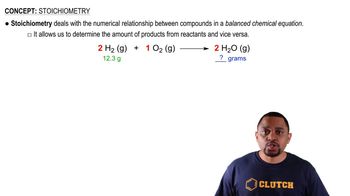
Stoichiometry

Stoichiometry is the area of chemistry that deals with the relationships between the quantities of reactants and products in chemical reactions. It is based on the conservation of mass and the mole concept, enabling calculations of how much of one substance is needed to react with a given amount of another. Understanding stoichiometry is essential for interpreting statements about quantities in chemical contexts.
추천 영상:
가이드 코스
01:16
Stoichiometry Concept

Animal Anatomy

In this context, understanding the anatomy of horses is crucial. Each horse typically has four legs, which means that a mole of horses would contain four moles of horse legs. This biological knowledge helps clarify the relationship between the number of horses and the number of legs, illustrating how stoichiometric relationships can apply to real-world scenarios.