Ch.3 - Chemical Reactions and Reaction Stoichiometry
Brown - Chemistry: The Central Science 14th Edition
Brown14th EditionChemistry: The Central ScienceISBN: 9780134414232당신이 사용하는 게 아니라요?교과서 변경
3장, 문제 29b

(a) Write 'true' or 'false' for each statement. (b) A mole of water has a mass of 18.0 g.

검증된 단계별 안내
1
(a) To determine if a statement is 'true' or 'false', evaluate the accuracy of the statement based on known chemical principles or data.
(b) Understand that a mole is a unit in chemistry that represents Avogadro's number (approximately 6.022 x 10^23) of particles, atoms, or molecules.
(b) Calculate the molar mass of water (H2O) by adding the atomic masses of its constituent elements: 2 hydrogen atoms and 1 oxygen atom.
(b) The atomic mass of hydrogen is approximately 1.0 g/mol, and the atomic mass of oxygen is approximately 16.0 g/mol.
(b) Add the atomic masses: (2 x 1.0 g/mol) + (1 x 16.0 g/mol) to find the molar mass of water, which should confirm the given mass of a mole of water.

비슷한 문제에 대한 검증된 영상 답변:

이 영상 해법은 위 문제에 도움이 된다고 튜터들이 추천한 것입니다.
영상 길이:
59s

주요 개념

질문에 올바르게 답하기 위해 반드시 이해해야 하는 핵심 개념들은 다음과 같습니다.

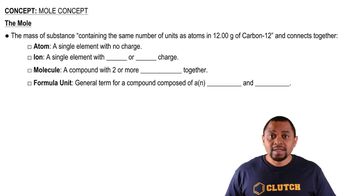
Mole Concept

The mole is a fundamental unit in chemistry that quantifies the amount of substance. One mole contains approximately 6.022 x 10^23 entities, such as atoms or molecules. This concept allows chemists to convert between the mass of a substance and the number of particles it contains, facilitating stoichiometric calculations.
추천 영상:

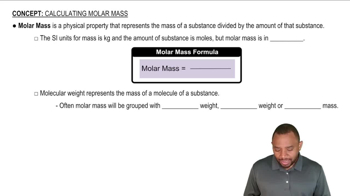
Molar Mass

Molar mass is the mass of one mole of a substance, typically expressed in grams per mole (g/mol). For water (H2O), the molar mass is calculated by summing the atomic masses of its constituent elements: hydrogen (1.01 g/mol) and oxygen (16.00 g/mol), resulting in a total of approximately 18.0 g/mol. This value is crucial for converting between mass and moles.
추천 영상:
가이드 코스
02:11
Molar Mass Concept

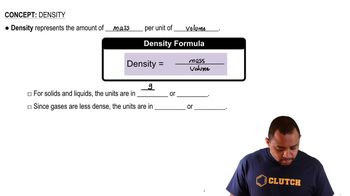
Density and Mass Relationships

Understanding the relationship between mass, volume, and density is essential in chemistry. Density is defined as mass per unit volume (d = m/V). For water, knowing its density (1 g/cm³) helps confirm that a mole of water, which has a mass of 18.0 g, occupies a volume of about 18.0 cm³, reinforcing the connection between these properties.
추천 영상:
가이드 코스
01:56
Density Concepts