Ch.3 - Chemical Reactions and Reaction Stoichiometry
Brown - Chemistry: The Central Science 14th Edition
Brown14th EditionChemistry: The Central ScienceISBN: 9780134414232당신이 사용하는 게 아니라요?교과서 변경
3장, 문제 74c

(c) Can a reaction ever have 110% actual yield?

검증된 단계별 안내
1
insert step 1> Understand the concept of actual yield and theoretical yield. Actual yield is the amount of product obtained from a chemical reaction, while theoretical yield is the maximum amount of product that could be formed from the given reactants, assuming perfect conditions.
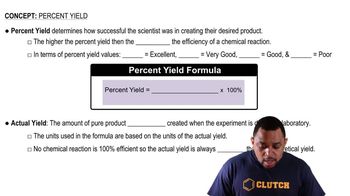
insert step 2> Recognize that the percent yield is calculated using the formula: \( \text{Percent Yield} = \left( \frac{\text{Actual Yield}}{\text{Theoretical Yield}} \right) \times 100\% \).
insert step 3> Consider the implications of a percent yield greater than 100%. A percent yield over 100% would imply that more product was obtained than theoretically possible, which suggests an error in the experiment or measurement.
insert step 4> Identify potential reasons for a percent yield over 100%, such as measurement errors, impurities in the product, or side reactions that produce additional product.
insert step 5> Conclude that while a reaction can be reported to have a percent yield over 100%, it typically indicates an error or anomaly, as it is not physically possible to obtain more product than the theoretical maximum.

비슷한 문제에 대한 검증된 영상 답변:

이 영상 해법은 위 문제에 도움이 된다고 튜터들이 추천한 것입니다.
영상 길이:
1m

주요 개념

질문에 올바르게 답하기 위해 반드시 이해해야 하는 핵심 개념들은 다음과 같습니다.

Actual Yield

Actual yield refers to the amount of product that is actually obtained from a chemical reaction, measured in grams or moles. It is determined through experimental procedures and can vary due to factors such as incomplete reactions, side reactions, or losses during product recovery. Understanding actual yield is crucial for evaluating the efficiency of a reaction.
추천 영상:
가이드 코스
03:09
Percent Yield in Reactions

Theoretical Yield

Theoretical yield is the maximum amount of product that could be formed from a given amount of reactants, assuming complete conversion and no losses. It is calculated based on stoichiometric ratios derived from balanced chemical equations. Theoretical yield serves as a benchmark against which actual yield is compared to assess the efficiency of a reaction.
추천 영상:
가이드 코스
03:09
Percent Yield in Reactions

Percent Yield

Percent yield is a measure of the efficiency of a chemical reaction, calculated by dividing the actual yield by the theoretical yield and multiplying by 100. It provides insight into how well a reaction proceeds and is expressed as a percentage. A percent yield greater than 100% indicates an error in measurement or calculation, as it is impossible to produce more product than theoretically possible.
추천 영상:
가이드 코스
03:09
Percent Yield in Reactions