Ch.3 - Chemical Reactions and Reaction Stoichiometry
Brown - Chemistry: The Central Science 14th Edition
Brown14th EditionChemistry: The Central ScienceISBN: 9780134414232당신이 사용하는 게 아니라요?교과서 변경
3장, 문제 73c

(c) Why should you base your choice of which compound is the limiting reactant on its number of initial moles, not on its initial mass in grams?

검증된 단계별 안내
1
Understand the concept of a limiting reactant: The limiting reactant in a chemical reaction is the substance that is totally consumed when the chemical reaction is complete. The amount of product formed is limited by this reactant since the reaction cannot continue without it.
Recognize the difference between moles and mass: Moles measure the number of particles in a substance, which directly correlates to the number of reactant particles available to react. Mass, on the other hand, measures the weight of these particles, which varies depending on the molecular weight of each substance.
Convert mass to moles for comparison: To accurately determine which reactant will limit the reaction, convert the mass of each reactant into moles using their respective molar masses. This step is crucial because it aligns the units of measure, allowing for a direct comparison of the reactants' availability for the reaction.
Compare the stoichiometric ratios: Use the balanced chemical equation to compare the mole ratios of the reactants. This comparison will help you determine which reactant is in insufficient quantity relative to the others, according to the stoichiometric requirements of the reaction.
Identify the limiting reactant: The reactant that has the smallest ratio of available moles to required moles (as per the balanced equation) is the limiting reactant. This is because it will be consumed first, stopping the reaction, regardless of the amounts of other reactants present.

비슷한 문제에 대한 검증된 영상 답변:

이 영상 해법은 위 문제에 도움이 된다고 튜터들이 추천한 것입니다.
영상 길이:
2m
도움이 되었나요?

주요 개념

질문에 올바르게 답하기 위해 반드시 이해해야 하는 핵심 개념들은 다음과 같습니다.

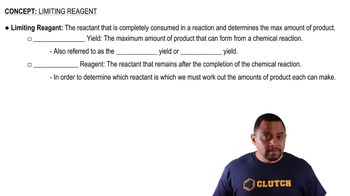
Limiting Reactant

The limiting reactant is the substance that is completely consumed in a chemical reaction, thus determining the maximum amount of product that can be formed. It is essential to identify this reactant to predict the yield of the reaction accurately. The reactant that runs out first limits the reaction's progress, making it crucial for stoichiometric calculations.
추천 영상:
가이드 코스
01:30
Limiting Reagent Concept

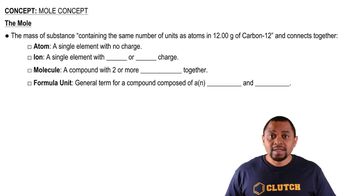
Mole Concept

The mole is a fundamental unit in chemistry that quantifies the amount of substance. One mole corresponds to Avogadro's number (approximately 6.022 x 10²³) of particles, such as atoms or molecules. Using moles allows chemists to relate mass to the number of particles, facilitating comparisons between reactants in a reaction based on their stoichiometric ratios.
추천 영상:

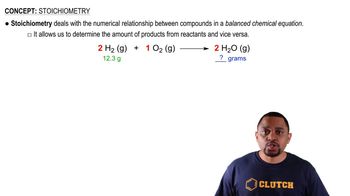
Stoichiometry

Stoichiometry is the calculation of reactants and products in chemical reactions based on balanced equations. It involves using the mole ratios derived from the coefficients in a balanced equation to determine how much of each reactant is needed or how much product can be formed. This concept is vital for understanding how initial moles, rather than mass, dictate the limiting reactant in a reaction.
추천 영상:
가이드 코스
01:16
Stoichiometry Concept