Ch.3 - Chemical Reactions and Reaction Stoichiometry
Brown - Chemistry: The Central Science 14th Edition
Brown14th EditionChemistry: The Central ScienceISBN: 9780134414232당신이 사용하는 게 아니라요?교과서 변경
3장, 문제 25b

Calculate the percentage by mass of oxygen in the following compounds: (b) isopropyl alcohol, C3H8O

검증된 단계별 안내
1
Step 1: Determine the molar mass of each element in the compound. The molar mass of carbon (C) is approximately 12.01 g/mol, hydrogen (H) is approximately 1.01 g/mol, and oxygen (O) is approximately 16.00 g/mol.
Step 2: Calculate the molar mass of the compound. Isopropyl alcohol, C3H8O, has 3 carbon atoms, 8 hydrogen atoms, and 1 oxygen atom. So, the molar mass of the compound is (3*12.01 g/mol) + (8*1.01 g/mol) + (1*16.00 g/mol).
Step 3: Calculate the total mass of oxygen in the compound. Since there is only one oxygen atom in the compound, the total mass of oxygen is 16.00 g/mol.
Step 4: Calculate the percentage by mass of oxygen in the compound. The formula to calculate the percentage by mass is (mass of the element / molar mass of the compound) * 100%.
Step 5: Substitute the values into the formula. The mass of oxygen is 16.00 g/mol and the molar mass of the compound is the value calculated in step 2. Substitute these values into the formula and calculate the percentage.

비슷한 문제에 대한 검증된 영상 답변:

이 영상 해법은 위 문제에 도움이 된다고 튜터들이 추천한 것입니다.
영상 길이:
2m

주요 개념

질문에 올바르게 답하기 위해 반드시 이해해야 하는 핵심 개념들은 다음과 같습니다.

Molar Mass Calculation

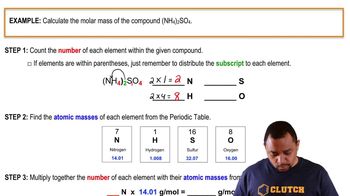
Molar mass is the mass of one mole of a substance, typically expressed in grams per mole (g/mol). To calculate the molar mass of a compound, sum the atomic masses of all the atoms in its molecular formula. For isopropyl alcohol (C3H8O), this involves calculating the contributions from carbon (C), hydrogen (H), and oxygen (O) to find the total molar mass.
추천 영상:
가이드 코스
03:12
Molar Mass Calculation Example

Percentage by Mass

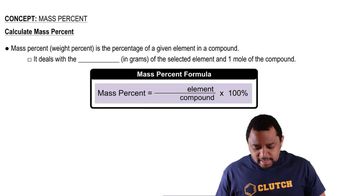
Percentage by mass is a way to express the concentration of an element in a compound. It is calculated by dividing the mass of the element in one mole of the compound by the total molar mass of the compound, then multiplying by 100. This gives a clear representation of how much of the compound's mass is due to a specific element, such as oxygen in isopropyl alcohol.
추천 영상:
가이드 코스
00:38
Mass Percent Calculation

Empirical and Molecular Formulas

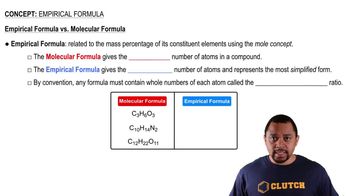
The empirical formula represents the simplest whole-number ratio of elements in a compound, while the molecular formula shows the actual number of each type of atom in a molecule. Understanding the difference is crucial when calculating mass percentages, as the molecular formula (C3H8O) provides the exact composition needed for accurate molar mass and percentage calculations.
추천 영상:
가이드 코스
02:26
Empirical vs Molecular Formula