Ch.3 - Chemical Reactions and Reaction Stoichiometry
Brown - Chemistry: The Central Science 14th Edition
Brown14th EditionChemistry: The Central ScienceISBN: 9780134414232당신이 사용하는 게 아니라요?교과서 변경
3장, 문제 85

Hydrogen sulfide is an impurity in natural gas that must be removed. One common removal method is called the Claus process, which relies on the reaction: 8 H2S1g2 + 4 O21g2¡S81l2 + 8 H2O1g2 Under optimal conditions the Claus process gives 98% yield of S8 from H2S. If you started with 30.0 g of H2S and 50.0 g of O2, how many grams of S8 would be produced, assuming 98% yield?

검증된 단계별 안내
1
Calculate the molar mass of H2S and O2 to convert the given masses to moles.
Determine the limiting reactant by comparing the mole ratio of H2S to O2 from the balanced equation.
Use the stoichiometry of the balanced equation to find the theoretical yield of S8 in moles based on the limiting reactant.
Convert the theoretical yield of S8 from moles to grams using the molar mass of S8.
Calculate the actual yield of S8 by applying the 98% yield to the theoretical yield in grams.

비슷한 문제에 대한 검증된 영상 답변:

이 영상 해법은 위 문제에 도움이 된다고 튜터들이 추천한 것입니다.
영상 길이:
6m

주요 개념

질문에 올바르게 답하기 위해 반드시 이해해야 하는 핵심 개념들은 다음과 같습니다.

Stoichiometry

Stoichiometry is the calculation of reactants and products in chemical reactions based on the balanced chemical equation. It allows us to determine the amount of product formed from a given amount of reactants by using mole ratios derived from the coefficients in the balanced equation. In this case, understanding the stoichiometric relationships between H2S and S8 is essential to calculate the theoretical yield of sulfur.
추천 영상:
가이드 코스
01:16
Stoichiometry Concept

Limiting Reactant

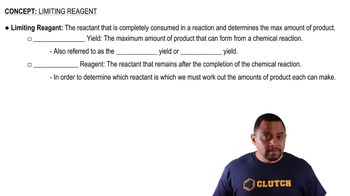
The limiting reactant is the substance that is completely consumed first in a chemical reaction, thus determining the maximum amount of product that can be formed. To find the limiting reactant, one must compare the mole ratios of the reactants used in the reaction. In the Claus process, identifying whether H2S or O2 is the limiting reactant is crucial for calculating the actual yield of S8.
추천 영상:
가이드 코스
01:30
Limiting Reagent Concept

Percent Yield

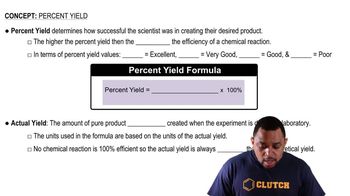
Percent yield is a measure of the efficiency of a chemical reaction, calculated by comparing the actual yield of a product to the theoretical yield, expressed as a percentage. In this scenario, the Claus process has a 98% yield, meaning that only 98% of the theoretical amount of S8 will be produced from the limiting reactant. This concept is vital for determining the final amount of S8 produced from the initial quantities of H2S and O2.
추천 영상:
가이드 코스
03:09
Percent Yield in Reactions
관련 실천
교과서 질문

When benzene 1C6H62 reacts with bromine 1Br22, bromobenzene 1C6H5Br2 is obtained: C6H6 + Br2¡C6H5Br + HBr (a) When 30.0 g of benzene reacts with 65.0 g of bromine, what is the theoretical yield of bromobenzene?

1440
views
1
rank

교과서 질문

When ethane 1C2H62 reacts with chlorine 1Cl22, the main product is C2H5Cl, but other products containing Cl, such as C2H4Cl2, are also obtained in small quantities. The formation of these other products reduces the yield of C2H5Cl. (a) Calculate the theoretical yield of C2H5Cl when 125 g of C2H6 reacts with 255 g of Cl2, assuming that C2H6 and Cl2 react only to form C2H2Cl and HCl. (b) Calculate the percent yield of C2H5Cl if the reaction produces 206 g of C2H5Cl.

1309
views
교과서 질문

When hydrogen sulfide gas is bubbled into a solution of sodium hydroxide, the reaction forms sodium sulfide and water. How many grams of sodium sulfide are formed if 1.25 g of hydrogen sulfide is bubbled into a solution containing 2.00 g of sodium hydroxide, assuming that the sodium sulfide is made in 92.0% yield?

2678
views
교과서 질문

When benzene 1C6H62 reacts with bromine 1Br22, bromobenzene 1C6H5Br2 is obtained: C6H6 + Br2¡C6H5Br + HBr (b) If the actual yield of bromobenzene is 42.3 g, what is the percentage yield?

740
views
1
rank
교과서 질문

Write balanced chemical equations for (a) the complete combustion of acetone (CH3COCH3), a common organic solvent (b) the decomposition of solid mercury (I) carbonate into carbon dioxide gas, mercury, and solid mercury oxide

1077
views
교과서 질문

Write balanced chemical equations for (c) the combination reaction between nickel metal and chlorine gas.

464
views