Separate samples of a solution of an unknown ionic compound are treated with dilute AgNO3, Pb1NO322, and BaCl2. Precipitates form in all three cases. Which of the following could be the anion of the unknown salt: Br-, CO32-, NO3-?
Ch.4 - Reactions in Aqueous Solution
4장, 문제 29
You know that an unlabeled bottle contains an aqueous solution of one of the following: AgNO3, CaCl2, or Al21SO423. A friend suggests that you test a portion of the solution with Ba1NO322 and then with NaCl solutions. According to your friend's logic, which of these chemical reactions could occur, thus helping you identify the solution in the bottle? (a) Barium sulfate could precipitate. (b) Silver chloride could precipitate. (c) Silver sulfate could precipitate. (d) More than one, but not all, of the reactions described in answers a–c could occur. (e) All three reactions described in answers a–c could occur.
검증된 단계별 안내1
Identify the possible reactions with Ba(NO_3)_2: Ba(NO_3)_2 can react with SO_4^{2-} to form BaSO_4, a precipitate, if the solution contains Al_2(SO_4)_3.
Identify the possible reactions with NaCl: NaCl can react with Ag^+ to form AgCl, a precipitate, if the solution contains AgNO_3.
Consider the solubility rules: BaSO_4 and AgCl are both insoluble in water, leading to precipitation, while Ag_2SO_4 is slightly soluble.
Evaluate the possible outcomes: If BaSO_4 precipitates, the solution is Al_2(SO_4)_3. If AgCl precipitates, the solution is AgNO_3.
Determine the correct answer: Based on the reactions, both (a) and (b) could occur, so the correct choice is (d) More than one, but not all, of the reactions described in answers a–c could occur.

비슷한 문제에 대한 검증된 영상 답변:
이 영상 해법은 위 문제에 도움이 된다고 튜터들이 추천한 것입니다.
영상 길이:
2m도움이 되었나요?
주요 개념
질문에 올바르게 답하기 위해 반드시 이해해야 하는 핵심 개념들은 다음과 같습니다.
Precipitation Reactions
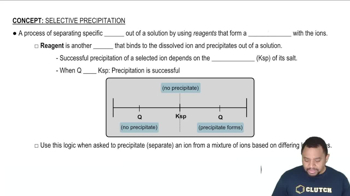
Precipitation reactions occur when two soluble salts react in solution to form an insoluble compound, known as a precipitate. This process is driven by the formation of a product that is less soluble than the reactants, leading to its separation from the solution. Understanding the solubility rules helps predict which combinations of ions will result in a precipitate.
추천 영상:
가이드 코스
Selective Precipitation
Solubility Rules
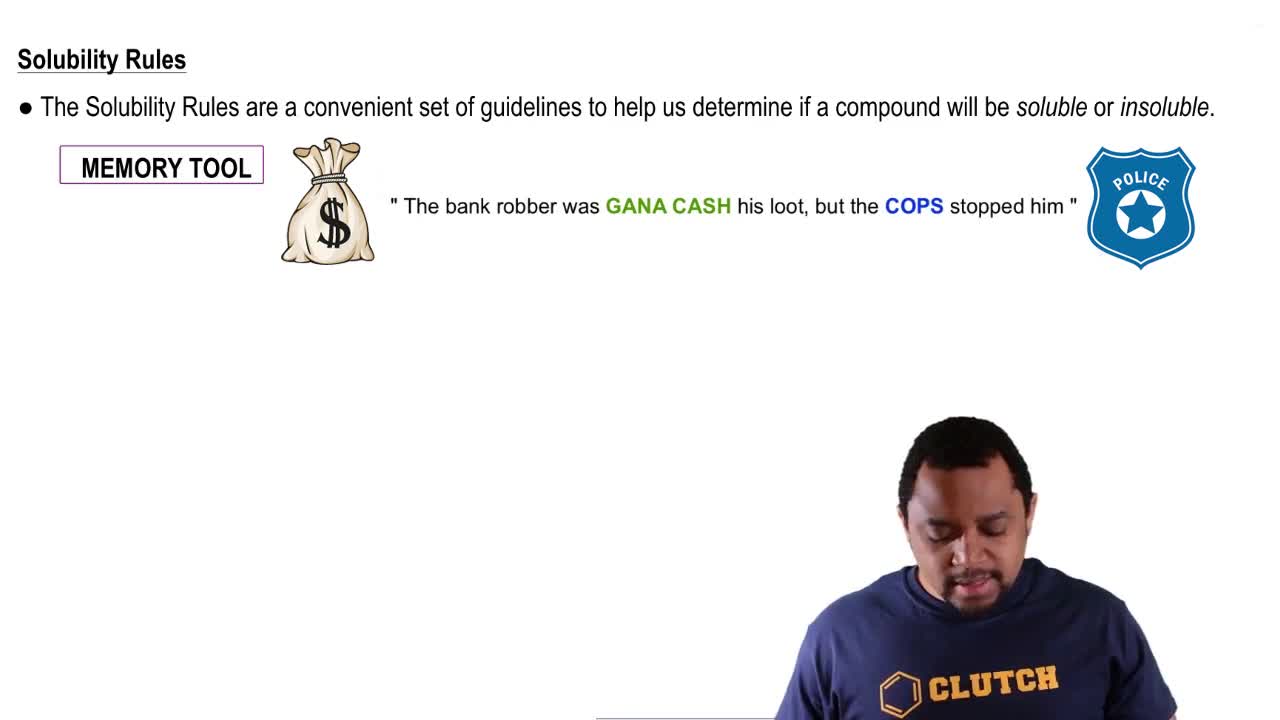
Solubility rules are guidelines that help predict whether a compound will dissolve in water. For example, most sulfates are soluble, except for those of barium, lead, and calcium, while chlorides are generally soluble except for silver and lead. Knowing these rules is essential for determining which reactions will produce precipitates in the given scenario.
추천 영상:
가이드 코스
Solubility Rules
Ionic Compounds and Their Reactions
Ionic compounds, such as AgNO3, CaCl2, and Al2(SO4)3, dissociate into their constituent ions in aqueous solutions. When mixed with other ionic solutions, these ions can recombine to form new compounds. Identifying the ions present in the original solution allows for predicting possible reactions with Ba(NO3)2 and NaCl, leading to the formation of precipitates like barium sulfate or silver chloride.
추천 영상:
가이드 코스
Ionic Compounds Naming
관련 실천
교과서 질문
1171
views
교과서 질문
State whether each of the following statements is true or false. Justify your answer in each case. (b) HCl is a weak acid.
330
views
교과서 질문
State whether each of the following statements is true or false. Justify your answer in each case. (a) Sulfuric acid is a monoprotic acid.
341
views
교과서 질문
Write balanced net ionic equations for the reactions that occur in each of the following cases. Identify the spectator ion or ions in each reaction. (c) Na2S(aq) + CoSO4(aq) →
605
views
교과서 질문
Three solutions are mixed together to form a single solution; in the final solution, there are 0.2 mol Pb1CH3COO)2, 0.1 mol Na2S, and 0.1 mol CaCl2 present. What solid(s) will precipitate?
2338
views
4
rank