Ch.4 - Reactions in Aqueous Solution
Brown - Chemistry: The Central Science 14th Edition
Brown14th EditionChemistry: The Central ScienceISBN: 9780134414232당신이 사용하는 게 아니라요?교과서 변경
4장, 문제 87a

A solution of 100.0 mL of 0.200 M KOH is mixed with a solution of 200.0 mL of 0.150 M NiSO4. (a) Write the balanced chemical equation for the reaction that occurs.

검증된 단계별 안내
1
Identify the reactants: KOH and NiSO_4.
Determine the products of the reaction: KOH is a strong base and NiSO_4 is a salt, so they will undergo a double displacement reaction to form Ni(OH)_2 and K_2SO_4.
Write the unbalanced chemical equation: KOH + NiSO_4 -> Ni(OH)_2 + K_2SO_4.
Balance the chemical equation by ensuring the same number of each type of atom on both sides of the equation.
The balanced chemical equation is: 2 KOH + NiSO_4 -> Ni(OH)_2 + K_2SO_4.

비슷한 문제에 대한 검증된 영상 답변:

이 영상 해법은 위 문제에 도움이 된다고 튜터들이 추천한 것입니다.
영상 길이:
2m

주요 개념

질문에 올바르게 답하기 위해 반드시 이해해야 하는 핵심 개념들은 다음과 같습니다.

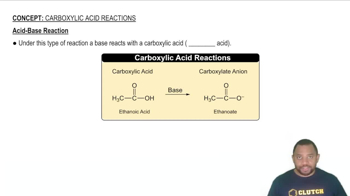
Acid-Base Reactions

Acid-base reactions involve the transfer of protons (H+) between reactants. In this case, KOH acts as a strong base, providing hydroxide ions (OH-) that can react with metal cations. Understanding the nature of acids and bases is crucial for predicting the products of the reaction.
추천 영상:
가이드 코스
01:09
Acid-Base Reaction

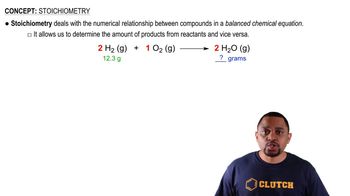
Stoichiometry

Stoichiometry is the calculation of reactants and products in chemical reactions based on balanced equations. It allows us to determine the proportions of KOH and NiSO4 that will react, which is essential for writing the balanced chemical equation and understanding the quantities involved.
추천 영상:
가이드 코스
01:16
Stoichiometry Concept

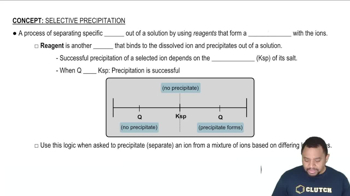
Precipitation Reactions

Precipitation reactions occur when two soluble salts react to form an insoluble compound, or precipitate. In this scenario, the reaction between KOH and NiSO4 may produce nickel hydroxide (Ni(OH)2), which is insoluble in water. Recognizing the solubility rules helps in identifying the products of the reaction.
추천 영상:
가이드 코스
01:53
Selective Precipitation
관련 실천
교과서 질문

A solution is made by mixing 1.5 g of LiOH and 23.5 mL of 1.000 M HNO3. (b) Calculate the concentration of each ion remaining in solution.

588
views

교과서 질문

A 4.36-g sample of an unknown alkali metal hydroxide is dissolved in 100.0 mL of water. An acid–base indicator is added, and the resulting solution is titrated with 2.50 M HCl(aq) solution. The indicator changes color, signaling that the equivalence point has been reached, after 17.0 mL of the hydrochloric acid solution has been added. (b) What is the identity of the alkali metal cation: Li+, Na+, K+, Rb+, or Cs+?

455
views
교과서 질문

A solution of 100.0 mL of 0.200 M KOH is mixed with a solution of 200.0 mL of 0.150 M NiSO4. (b) What precipitate forms?

383
views
교과서 질문

A solution of 100.0 mL of 0.200 M KOH is mixed with a solution of 200.0 mL of 0.150 M NiSO4. (e) What is the concentration of each ion that remains in solution?

998
views
교과서 질문

A 4.36-g sample of an unknown alkali metal hydroxide is dissolved in 100.0 mL of water. An acid–base indicator is added, and the resulting solution is titrated with 2.50 M HCl(aq) solution. The indicator changes color, signaling that the equivalence point has been reached, after 17.0 mL of the hydrochloric acid solution has been added. (a) What is the molar mass of the metal hydroxide?

1602
views
교과서 질문

An 8.65-g sample of an unknown group 2 metal hydroxide is dissolved in 85.0 mL of water. An acid–base indicator is added and the resulting solution is titrated with 2.50 M HCl(aq) solution. The indicator changes color, signaling that the equivalence point has been reached, after 56.9 mL of the hydrochloric acid solution has been added. (a) What is the molar mass of the metal hydroxide? (b) What is the identity of the metal cation: Ca2+, Sr2+, or Ba2+?

1120
views