Ch.4 - Reactions in Aqueous Solution
Brown - Chemistry: The Central Science 14th Edition
Brown14th EditionChemistry: The Central ScienceISBN: 9780134414232당신이 사용하는 게 아니라요?교과서 변경
4장, 문제 47b

(a) Which region of the periodic table shown here contains elements that are easiest to oxidize? (b) Which region contains the least readily oxidized elements?
Periodic table highlighting regions for oxidizing elements in red and least oxidized in blue.

검증된 단계별 안내
1
Identify the regions in the periodic table that are color-coded.
Note that the red region (A) represents the elements that are easiest to oxidize.
Observe that the blue region (D) represents the elements that are least readily oxidized.
For part (a), locate the red region (A) on the periodic table, which includes Group 1A (alkali metals) and Group 8A (noble gases).
For part (b), locate the blue region (D) on the periodic table, which includes the transition metals and some post-transition metals.

비슷한 문제에 대한 검증된 영상 답변:

이 영상 해법은 위 문제에 도움이 된다고 튜터들이 추천한 것입니다.
영상 길이:
1m
도움이 되었나요?

주요 개념

질문에 올바르게 답하기 위해 반드시 이해해야 하는 핵심 개념들은 다음과 같습니다.

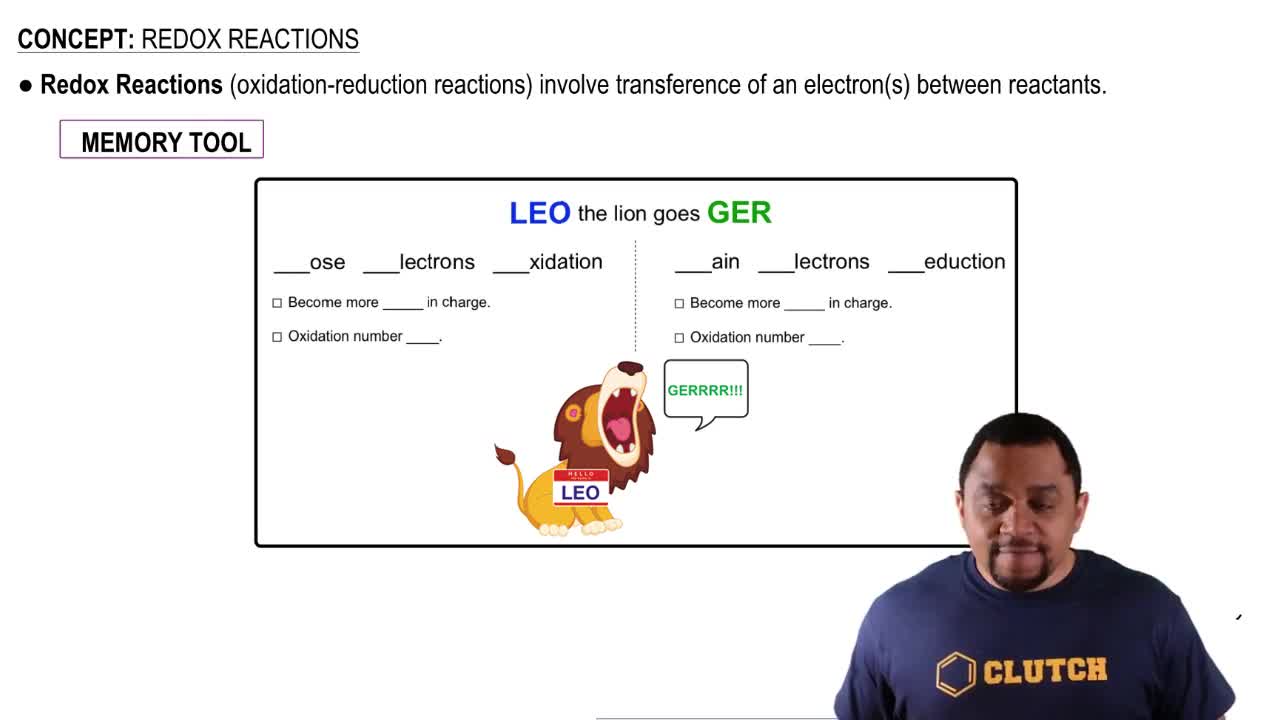
Oxidation and Reduction

Oxidation refers to the loss of electrons by an atom or ion, while reduction is the gain of electrons. In chemical reactions, these processes occur simultaneously, known as redox reactions. Elements that easily lose electrons are considered good reducing agents and are typically found in specific regions of the periodic table, particularly the alkali metals and alkaline earth metals.
추천 영상:
가이드 코스
01:53
Oxidation and Reduction Reactions

Periodic Trends in Reactivity

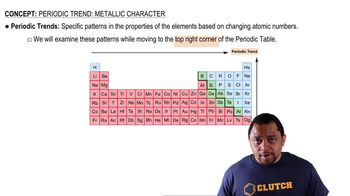
The reactivity of elements varies across the periodic table, influenced by their electron configurations. Generally, metals located on the left side and bottom of the table, such as alkali metals, are more reactive and easily oxidized. Conversely, nonmetals on the right side, particularly noble gases, are less reactive and less readily oxidized due to their stable electron configurations.
추천 영상:
가이드 코스
00:38
Periodic Trends

Position of Elements in the Periodic Table

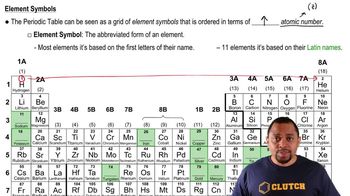
The periodic table is organized by increasing atomic number, with elements grouped by similar properties. The leftmost columns (Groups 1 and 2) contain highly reactive metals that readily oxidize, while the rightmost columns (Groups 15 to 18) include nonmetals and noble gases, which are less likely to oxidize. Understanding this layout is crucial for predicting the behavior of elements in chemical reactions.
추천 영상:
가이드 코스
04:01
Periodic Table History