Ch.4 - Reactions in Aqueous Solution
Brown - Chemistry: The Central Science 14th Edition
Brown14th EditionChemistry: The Central ScienceISBN: 9780134414232당신이 사용하는 게 아니라요?교과서 변경
4장, 문제 58a

The following reactions (note that the arrows are pointing only one direction) can be used to prepare an activity series for the halogens:
Br2(aq) + 2 NaI(aq) → 2 NaBr(aq) + I2(aq)
Cl2(aq) + 2 NaBr(aq) → 2 NaCl(aq) + Br2(aq)
(a) Which elemental halogen would you predict is the most stable, upon mixing with other halides?

검증된 단계별 안내
1
Identify the reactions given: \( \text{Br}_2 + 2 \text{NaI} \rightarrow 2 \text{NaBr} + \text{I}_2 \) and \( \text{Cl}_2 + 2 \text{NaBr} \rightarrow 2 \text{NaCl} + \text{Br}_2 \).
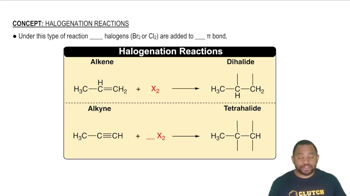
Recognize that these reactions are single displacement reactions where a more reactive halogen displaces a less reactive halogen from its compound.
In the first reaction, \( \text{Br}_2 \) displaces \( \text{I}_2 \), indicating that \( \text{Br}_2 \) is more reactive than \( \text{I}_2 \).
In the second reaction, \( \text{Cl}_2 \) displaces \( \text{Br}_2 \), indicating that \( \text{Cl}_2 \) is more reactive than \( \text{Br}_2 \).
Conclude that \( \text{Cl}_2 \) is the most reactive and therefore the least stable when mixed with other halides, while \( \text{I}_2 \) is the least reactive and most stable.

비슷한 문제에 대한 검증된 영상 답변:

이 영상 해법은 위 문제에 도움이 된다고 튜터들이 추천한 것입니다.
영상 길이:
4m
도움이 되었나요?

주요 개념

질문에 올바르게 답하기 위해 반드시 이해해야 하는 핵심 개념들은 다음과 같습니다.

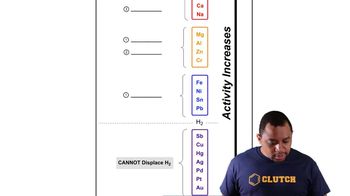
Activity Series

The activity series is a list of elements organized by their ability to displace other elements in reactions. In the context of halogens, it ranks them based on their reactivity, with more reactive halogens able to displace less reactive ones from their compounds. Understanding this series helps predict the outcomes of reactions involving halogens.
추천 영상:
가이드 코스
02:02
Activity Series Chart

Halogen Reactivity

Halogens are a group of elements in Group 17 of the periodic table, known for their high reactivity. Their reactivity decreases down the group, meaning fluorine is the most reactive, while iodine is the least. This trend is crucial for predicting which halogen will be more stable when mixed with other halides.
추천 영상:
가이드 코스
01:11
Halogenation Reactions

Stability of Halides

The stability of halides refers to how likely a halogen is to remain in its ionic or molecular form when mixed with other halides. More reactive halogens tend to form less stable compounds with other halides, while less reactive halogens are more stable. This concept is essential for determining which halogen would be the most stable in a given reaction.
추천 영상:
가이드 코스
03:13
Intepreting the Band of Stability
관련 실천
교과서 질문

(a) Is the number of moles of ions present in a solution an intensive or an extensive property?

448
views

교과서 질문

The metal cadmium tends to form Cd2+ ions. The following observations are made: (i) When a strip of zinc metal is placed in CdCl2(aq), cadmium metal is deposited on the strip. (ii) When a strip of cadmium metal is placed in Ni(NO3)(aq), nickel metal is deposited on the strip. (a) Write net ionic equations to explain each of the preceding observations.

1
views
교과서 질문

The metal cadmium tends to form Cd2+ ions. The following observations are made: (i) When a strip of zinc metal is placed in CdCl2(aq), cadmium metal is deposited on the strip. (ii) When a strip of cadmium metal is placed in Ni(NO3)(aq), nickel metal is deposited on the strip. (b) Which elements more closely define the position of cadmium in the activity series?

916
views
교과서 질문

Using the activity series (Table 4.5), write balanced chemical equations for the following reactions. If no reaction occurs, write NR. (e) hydrogen gas is bubbled through a solution of silver nitrate.

583
views
교과서 질문

The following reactions (note that the arrows are pointing only one direction) can be used to prepare an activity series for the halogens:

Br2(aq) + 2 NaI(aq) → 2 NaBr(aq) + I2(aq)

Cl2(aq) + 2 NaBr(aq) → 2 NaCl(aq) + Br2(aq)

(b) Predict whether a reaction will occur when elemental chlorine and potassium iodide are mixed.

1
views
교과서 질문

(b) Can you identify which one between 0.10 mol ZnCl2 and 0.1M ZnCl2 contains more Zn2+ ion? Why?

408
views