Ch.4 - Reactions in Aqueous Solution
Brown - Chemistry: The Central Science 14th Edition
Brown14th EditionChemistry: The Central ScienceISBN: 9780134414232당신이 사용하는 게 아니라요?교과서 변경
4장, 문제 57a

The metal cadmium tends to form Cd2+ ions. The following observations are made: (i) When a strip of zinc metal is placed in CdCl2(aq), cadmium metal is deposited on the strip. (ii) When a strip of cadmium metal is placed in Ni(NO3)(aq), nickel metal is deposited on the strip. (a) Write net ionic equations to explain each of the preceding observations.

검증된 단계별 안내
1
Step 1: Understand the concept of net ionic equations. These equations show only the species that actually change during the reaction, omitting spectator ions.
Step 2: For observation (i), identify the reactants and products. Zinc metal (Zn) is placed in cadmium chloride solution (CdCl2). Cadmium metal (Cd) is deposited, indicating a redox reaction where zinc is oxidized and cadmium is reduced.
Step 3: Write the half-reactions for observation (i). Zinc is oxidized: Zn → Zn2+ + 2e-. Cadmium is reduced: Cd2+ + 2e- → Cd.
Step 4: Combine the half-reactions for observation (i) to form the net ionic equation: Zn + Cd2+ → Zn2+ + Cd.
Step 5: For observation (ii), identify the reactants and products. Cadmium metal (Cd) is placed in nickel nitrate solution (Ni(NO3)2). Nickel metal (Ni) is deposited, indicating a redox reaction where cadmium is oxidized and nickel is reduced. Write the net ionic equation: Cd + Ni2+ → Cd2+ + Ni.

비슷한 문제에 대한 검증된 영상 답변:

이 영상 해법은 위 문제에 도움이 된다고 튜터들이 추천한 것입니다.
영상 길이:
2m

주요 개념

질문에 올바르게 답하기 위해 반드시 이해해야 하는 핵심 개념들은 다음과 같습니다.

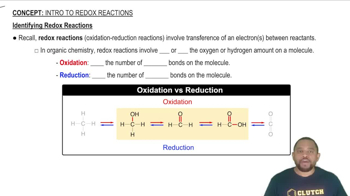
Redox Reactions

Redox reactions involve the transfer of electrons between species, leading to changes in oxidation states. In the context of the question, cadmium (Cd) is reduced from Cd^2+ to Cd metal, while zinc (Zn) is oxidized from Zn metal to Zn^2+. Understanding these electron transfers is crucial for writing the net ionic equations for the reactions observed.
추천 영상:
가이드 코스
03:12
Identifying Redox Reactions

Ionic Equations

Ionic equations represent the species involved in a chemical reaction in their ionic forms. In this case, the net ionic equations will show only the ions and molecules that participate in the reaction, excluding spectator ions. This simplification helps clarify the actual chemical changes occurring during the reactions with cadmium and zinc.
추천 영상:
가이드 코스
00:51
Net Ionic Equations

Electrochemical Series

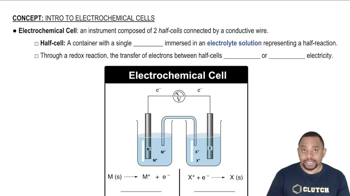
The electrochemical series ranks elements based on their standard electrode potentials, indicating their tendency to be oxidized or reduced. Zinc has a higher tendency to oxidize compared to cadmium, which explains why it can reduce Cd^2+ to Cd metal. Understanding this series is essential for predicting the outcomes of the metal displacement reactions described in the question.
추천 영상:
가이드 코스
02:46
Electrochemical Cells
관련 실천
교과서 질문

Using the activity series (Table 4.5), write balanced chemical equations for the following reactions. If no reaction occurs, write NR. (d) chromium metal is immersed in an aqueous solution of cobalt(II) chloride

735
views

교과서 질문

The following reactions (note that the arrows are pointing only one direction) can be used to prepare an activity series for the halogens:

Br2(aq) + 2 NaI(aq) → 2 NaBr(aq) + I2(aq)

Cl2(aq) + 2 NaBr(aq) → 2 NaCl(aq) + Br2(aq)

(a) Which elemental halogen would you predict is the most stable, upon mixing with other halides?

637
views
교과서 질문

The metal cadmium tends to form Cd2+ ions. The following observations are made: (i) When a strip of zinc metal is placed in CdCl2(aq), cadmium metal is deposited on the strip. (ii) When a strip of cadmium metal is placed in Ni(NO3)(aq), nickel metal is deposited on the strip. (b) Which elements more closely define the position of cadmium in the activity series?

916
views
교과서 질문

Using the activity series (Table 4.5), write balanced chemical equations for the following reactions. If no reaction occurs, write NR. (e) hydrogen gas is bubbled through a solution of silver nitrate.

583
views
교과서 질문

The following reactions (note that the arrows are pointing only one direction) can be used to prepare an activity series for the halogens:

Br2(aq) + 2 NaI(aq) → 2 NaBr(aq) + I2(aq)

Cl2(aq) + 2 NaBr(aq) → 2 NaCl(aq) + Br2(aq)

(b) Predict whether a reaction will occur when elemental chlorine and potassium iodide are mixed.

1
views
교과서 질문

Using the activity series (Table 4.5), write balanced chemical equations for the following reactions. If no reaction occurs, write NR. (b) a solution of zinc nitrate is added to a solution of magnesium sulfate (c) hydrochloric acid is added to gold metal

607
views