

Consider two solutions, the first being 50.0 mL of 1.00 M CuSO4 and the second 50.0 mL of 2.00 M KOH. When the two solutions are mixed in a constant-pressure calorimeter, a precipitate forms and the temperature of the mixture rises from 21.5 to 27.7 °C (d) From the calorimetric data, calculate ΔH for the reaction that occurs on mixing. Assume that the calorimeter absorbs only a negligible quantity of heat, that the total volume of the solution is 100.0 mL, and that the specific heat and density of the solution after mixing are the same as those of pure water.
Ch.5 - Thermochemistry
5장, 문제 125
A sample of a hydrocarbon is combusted completely in O21g2 to produce 21.83 g CO21g2, 4.47 g H2O1g2, and 311 kJ of heat. (a) What is the mass of the hydrocarbon sample that was combusted?
검증된 단계별 안내1
Identify the chemical reaction involved: The complete combustion of a hydrocarbon (CxHy) in oxygen (O2) produces carbon dioxide (CO2) and water (H2O).
Use the given masses of CO2 and H2O to determine the moles of each product formed. Use the molar mass of CO2 (44.01 g/mol) and H2O (18.02 g/mol) for these calculations.
Determine the moles of carbon and hydrogen in the hydrocarbon by using the stoichiometry of the combustion reaction. Each mole of CO2 corresponds to one mole of carbon, and each mole of H2O corresponds to two moles of hydrogen.
Calculate the mass of carbon and hydrogen in the hydrocarbon sample using their respective atomic masses (C: 12.01 g/mol, H: 1.008 g/mol).
Add the masses of carbon and hydrogen to find the total mass of the hydrocarbon sample that was combusted.

비슷한 문제에 대한 검증된 영상 답변:
이 영상 해법은 위 문제에 도움이 된다고 튜터들이 추천한 것입니다.
영상 길이:
2m주요 개념
질문에 올바르게 답하기 위해 반드시 이해해야 하는 핵심 개념들은 다음과 같습니다.
Combustion Reaction
A combustion reaction is a chemical process in which a substance (usually a hydrocarbon) reacts with oxygen to produce carbon dioxide and water, releasing energy in the form of heat. In this case, the complete combustion of the hydrocarbon generates specific amounts of CO2 and H2O, which can be used to determine the mass of the original hydrocarbon.
추천 영상:
가이드 코스
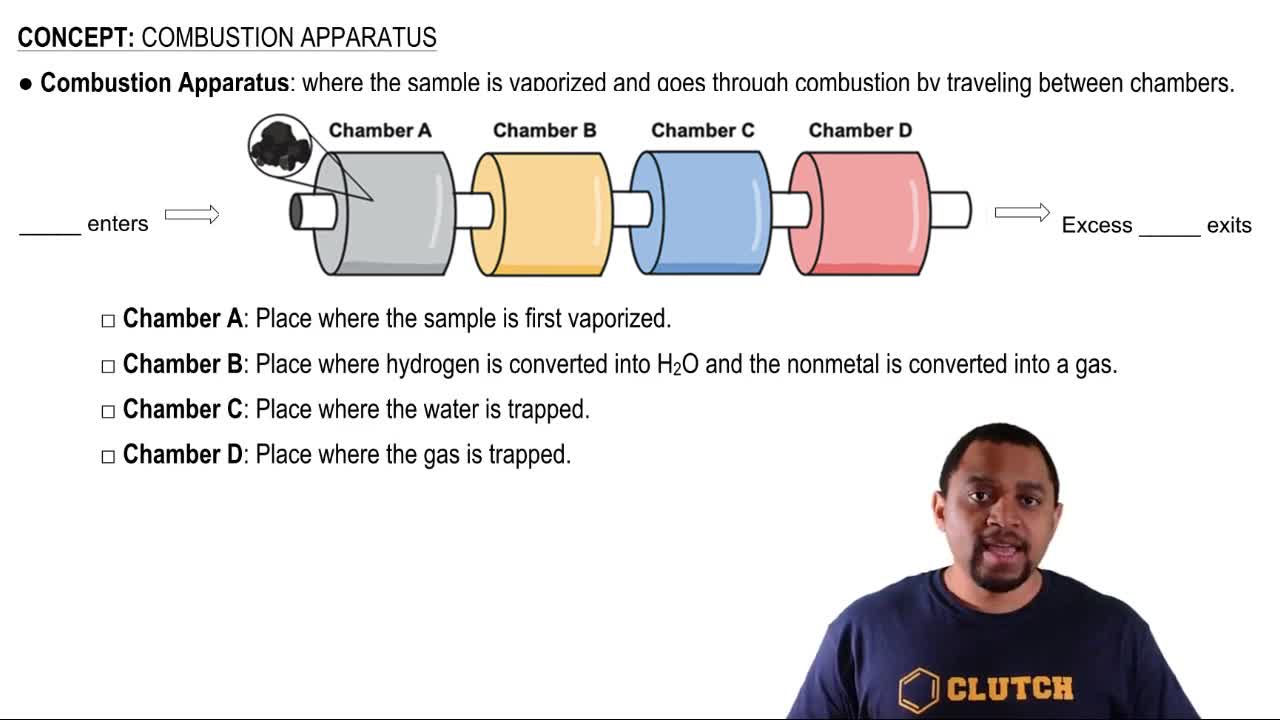
Combustion Apparatus
Stoichiometry
Stoichiometry is the calculation of reactants and products in chemical reactions based on the conservation of mass. It involves using molar ratios derived from balanced chemical equations to relate the amounts of substances consumed and produced. In this question, stoichiometry will help relate the masses of CO2 and H2O produced to the mass of the hydrocarbon that was combusted.
추천 영상:
가이드 코스
Stoichiometry Concept
Molar Mass
Molar mass is the mass of one mole of a substance, typically expressed in grams per mole (g/mol). It is essential for converting between the mass of a substance and the number of moles, which is crucial in stoichiometric calculations. To find the mass of the hydrocarbon, the molar masses of CO2 and H2O will be used to determine the moles produced, which can then be related back to the original hydrocarbon sample.
추천 영상:
가이드 코스
Molar Mass Concept
관련 실천
교과서 질문
1
views
교과서 질문
Consider two solutions, the first being 50.0 mL of 1.00 M CuSO4 and the second 50.0 mL of 2.00 M KOH. When the two solutions are mixed in a constant-pressure calorimeter, a precipitate forms and the temperature of the mixture rises from 21.5 to 27.7 °C. (a) Before mixing, how many grams of Cu are present in the solution of CuSO4?
980
views
교과서 질문
One of the best-selling light, or low-calorie, beers is 4.2%
alcohol by volume and a 355-mL serving contains 110
Calories; remember: 1 Calorie = 1000 cal = 1 kcal. To
estimate the percentage of Calories that comes from
the alcohol, consider the following questions.
(a) Write
a balanced chemical equation for the reaction of ethanol,
C2H5OH, with oxygen to make carbon dioxide
and water.
(b) Use enthalpies of formation in Appendix
C to determine ΔH for this reaction.
(c) If 4.2% of
the total volume is ethanol and the density of ethanol
is 0.789 g/mL, what mass of ethanol does a 355-mL serving
of light beer contain?
(d) How many Calories are
released by the metabolism of ethanol, the reaction from
part (a)?
(e) What percentage of the 110 Calories comes
from the ethanol?
663
views
교과서 질문
The methane molecule, CH4, has the geometry shown in
Figure 2.17. Imagine a hypothetical process in which the
methane molecule is 'expanded,' by simultaneously extending
all four C—H bonds to infinity. We then have the
process
CH41g2¡C1g2 + 4 H1g2
(a) Compare this process with the reverse of the reaction
that represents the standard enthalpy of formation of
CH41g2.
780
views
