
Consider two solutions, the first being 50.0 mL of 1.00 M CuSO4 and the second 50.0 mL of 2.00 M KOH. When the two solutions are mixed in a constant-pressure calorimeter, a precipitate forms and the temperature of the mixture rises from 21.5 to 27.7 °C (d) From the calorimetric data, calculate ΔH for the reaction that occurs on mixing. Assume that the calorimeter absorbs only a negligible quantity of heat, that the total volume of the solution is 100.0 mL, and that the specific heat and density of the solution after mixing are the same as those of pure water.
Ch.5 - Thermochemistry
5장, 문제 124
The precipitation reaction between AgNO3(aq) and NaCl(aq) proceeds as follows: AgNO3(aq) + NaCl(aq) → NaNO3(aq) + AgCl(s). (b) What would you expect for the value of _x001F_H° of the overall molecular equation compared to that for the net ionic equation? Explain.
검증된 단계별 안내1
Identify the overall molecular equation: AgNO3(aq) + NaCl(aq) → NaNO3(aq) + AgCl(s).
Write the net ionic equation by removing the spectator ions (Na+ and NO3-): Ag+(aq) + Cl-(aq) → AgCl(s).
Understand that the enthalpy change (ΔH°) for a reaction is related to the bonds broken and formed during the reaction.
Recognize that the overall molecular equation includes the formation of NaNO3(aq), which does not occur in the net ionic equation.
Conclude that the ΔH° for the overall molecular equation may differ from the net ionic equation due to the presence of additional processes (e.g., dissolution of NaNO3) in the overall equation.
주요 개념
질문에 올바르게 답하기 위해 반드시 이해해야 하는 핵심 개념들은 다음과 같습니다.
Precipitation Reactions
Precipitation reactions occur when two aqueous solutions react to form an insoluble solid, known as a precipitate. In this case, AgCl is formed from the reaction of AgNO3 and NaCl. Understanding the formation of precipitates is crucial for predicting the products of reactions and their thermodynamic properties.
추천 영상:
가이드 코스
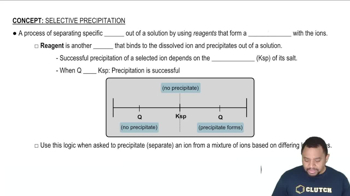
Selective Precipitation
Enthalpy Change (_x001F_H°)
Enthalpy change (_x001F_H°) refers to the heat content change during a chemical reaction at constant pressure. It is a key factor in thermodynamics, indicating whether a reaction is exothermic (releases heat) or endothermic (absorbs heat). The overall enthalpy change can differ between the complete molecular equation and the net ionic equation due to the cancellation of spectator ions.
추천 영상:
가이드 코스
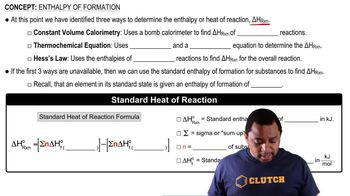
Enthalpy of Formation
Net Ionic Equations
Net ionic equations represent the actual chemical species that participate in a reaction, excluding spectator ions that do not change during the reaction. This simplification helps in analyzing the essential components of a reaction, particularly in terms of energy changes and reaction mechanisms, which is important for understanding the enthalpy changes associated with the reaction.
추천 영상:
가이드 코스
Net Ionic Equations
관련 실천
교과서 질문
1
views
교과서 질문
Consider two solutions, the first being 50.0 mL of 1.00 M CuSO4 and the second 50.0 mL of 2.00 M KOH. When the two solutions are mixed in a constant-pressure calorimeter, a precipitate forms and the temperature of the mixture rises from 21.5 to 27.7 °C. (a) Before mixing, how many grams of Cu are present in the solution of CuSO4?
980
views
교과서 질문
Consider the following acid-neutralization reactions involving
the strong base NaOH(aq):
HNO31aq2 + NaOH1aq2¡NaNO31aq2 + H2O1l2
HCl1aq2 + NaOH1aq2¡NaCl1aq2 + H2O1l2
NH4+1aq2 + NaOH1aq2¡NH31aq2 + Na+1aq2 + H2O1l2
(d) In the third equation NH4
+1aq2 is acting as an acid. Based
on the value of H° for this reaction, do you think it is a
strong or a weak acid? Explain.
739
views
교과서 질문
One of the best-selling light, or low-calorie, beers is 4.2%
alcohol by volume and a 355-mL serving contains 110
Calories; remember: 1 Calorie = 1000 cal = 1 kcal. To
estimate the percentage of Calories that comes from
the alcohol, consider the following questions.
(a) Write
a balanced chemical equation for the reaction of ethanol,
C2H5OH, with oxygen to make carbon dioxide
and water.
(b) Use enthalpies of formation in Appendix
C to determine ΔH for this reaction.
(c) If 4.2% of
the total volume is ethanol and the density of ethanol
is 0.789 g/mL, what mass of ethanol does a 355-mL serving
of light beer contain?
(d) How many Calories are
released by the metabolism of ethanol, the reaction from
part (a)?
(e) What percentage of the 110 Calories comes
from the ethanol?
663
views
교과서 질문
The methane molecule, CH4, has the geometry shown in
Figure 2.17. Imagine a hypothetical process in which the
methane molecule is 'expanded,' by simultaneously extending
all four C—H bonds to infinity. We then have the
process
CH41g2¡C1g2 + 4 H1g2
(a) Compare this process with the reverse of the reaction
that represents the standard enthalpy of formation of
CH41g2.
780
views
교과서 질문
A sample of a hydrocarbon is combusted completely in
O21g2 to produce 21.83 g CO21g2, 4.47 g H2O1g2, and 311 kJ of
heat. (a) What is the mass of the hydrocarbon sample that
was combusted?
718
views
