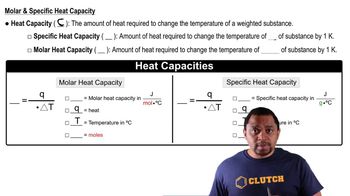
(a) What amount of heat (in joules) is required to raise the temperature of 1 g of water by 1 kelvin? (b) What amount of heat (in joules) is required to raise the temperature of 1 mole of water by 1 kelvin?

Ch.5 - Thermochemistry
5장, 문제 52
(b) Calculate the energy needed for this temperature change.
검증된 단계별 안내1
Identify the substance involved in the temperature change and its specific heat capacity (c).
Determine the mass (m) of the substance undergoing the temperature change.
Identify the initial (T_i) and final (T_f) temperatures of the substance.
Use the formula for calculating the energy change: \( q = m \cdot c \cdot \Delta T \), where \( \Delta T = T_f - T_i \).
Substitute the known values into the formula to calculate the energy (q) needed for the temperature change.

비슷한 문제에 대한 검증된 영상 답변:
이 영상 해법은 위 문제에 도움이 된다고 튜터들이 추천한 것입니다.
영상 길이:
1m도움이 되었나요?
주요 개념
질문에 올바르게 답하기 위해 반드시 이해해야 하는 핵심 개념들은 다음과 같습니다.
Specific Heat Capacity
Specific heat capacity is the amount of heat energy required to raise the temperature of one gram of a substance by one degree Celsius. It varies for different materials and is crucial for calculating energy changes during temperature changes. The formula used is Q = mcΔT, where Q is the heat energy, m is the mass, c is the specific heat capacity, and ΔT is the change in temperature.
추천 영상:
가이드 코스
Heat Capacity
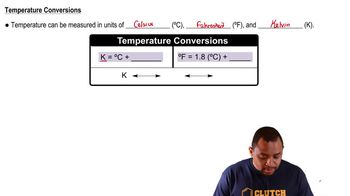
Temperature Change (ΔT)
Temperature change, denoted as ΔT, is the difference between the final and initial temperatures of a substance. It is a critical factor in energy calculations, as it directly influences the amount of energy absorbed or released. Understanding how to accurately determine ΔT is essential for solving problems related to heat transfer.
추천 영상:
가이드 코스
Temperature Conversion Formulas
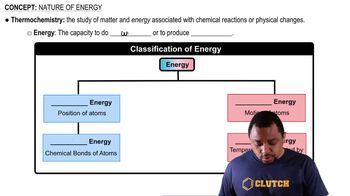
Energy Transfer
Energy transfer refers to the movement of energy from one system to another, often in the form of heat. In the context of temperature changes, energy is absorbed or released by a substance as it undergoes heating or cooling. This concept is fundamental in thermodynamics and is essential for calculating the energy required for temperature changes in various materials.
추천 영상:
가이드 코스
Nature of Energy
관련 실천
교과서 질문
교과서 질문
The specific heat of octane, C8H18(l), is 2.22 J•g/K. (b) Which will require more heat, increasing the temperature of 1 mol of C8H18(l), by a certain amount or increasing the temperature of 1 mol of H2O(l) by the same amount?
2232
views
교과서 질문
The specific heat of octane, C8H18(l), is 2.22 J•g/K. (a) How many J of heat are needed to raise the temperature of 80.0 g of octane from 10.0 to 25.0 °C?
1217
views
1
rank
교과서 질문
Consider the data about gold metal in Exercise 5.26(b). (a) Based on the data, calculate the specific heat of Au(s).
교과서 질문
(d) How many kJ of heat are needed to raise the temperature of 5.00 kg of liquid water from 24.6 to 46.2 °C?
1534
views
1
rank
교과서 질문
(c) What is the heat capacity of 185 g of liquid water?
676
views