
Ch.5 - Thermochemistry
Brown - Chemistry: The Central Science 14th Edition
Brown14th EditionChemistry: The Central ScienceISBN: 9780134414232당신이 사용하는 게 아니라요?교과서 변경
5장, 문제 56b

(b) Is this process endothermic or exothermic?

검증된 단계별 안내
1
insert step 1> Identify the process being described in the problem. Is it a chemical reaction, a phase change, or another type of process?
insert step 2> Determine if the process absorbs or releases energy. Endothermic processes absorb energy, while exothermic processes release energy.
insert step 3> Consider the context or any given data, such as temperature changes, heat flow, or enthalpy changes, to help identify the nature of the process.
insert step 4> If applicable, use the sign of the enthalpy change (ΔH) to determine the process type: a positive ΔH indicates an endothermic process, while a negative ΔH indicates an exothermic process.
insert step 5> Conclude whether the process is endothermic or exothermic based on the analysis from the previous steps.

비슷한 문제에 대한 검증된 영상 답변:

이 영상 해법은 위 문제에 도움이 된다고 튜터들이 추천한 것입니다.
영상 길이:
3m
도움이 되었나요?

주요 개념

질문에 올바르게 답하기 위해 반드시 이해해야 하는 핵심 개념들은 다음과 같습니다.

Endothermic Processes

Endothermic processes are chemical reactions or physical changes that absorb energy from their surroundings, usually in the form of heat. This results in a decrease in the temperature of the surrounding environment. A common example is the melting of ice, where heat is absorbed to convert solid ice into liquid water.
추천 영상:
가이드 코스
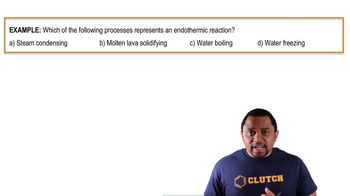
00:55
Endothermic & Exothermic Reactions Example 1

Exothermic Processes

Exothermic processes are reactions or changes that release energy, typically as heat, into the surroundings. This leads to an increase in the temperature of the environment. Combustion reactions, such as burning wood or gasoline, are classic examples of exothermic processes, as they produce heat and light.
추천 영상:
가이드 코스
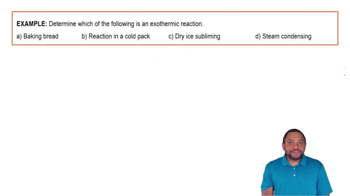
1:48
Endothermic & Exothermic Reactions Example 2

Thermodynamics

Thermodynamics is the branch of physical science that deals with the relationships between heat, work, temperature, and energy. It provides the framework for understanding whether a process is endothermic or exothermic by analyzing the energy changes involved. The first law of thermodynamics, which states that energy cannot be created or destroyed, is particularly relevant in determining the energy flow in chemical reactions.
추천 영상:
가이드 코스
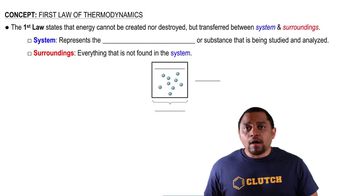
01:18
First Law of Thermodynamics
관련 실천
교과서 질문

When a 6.50-g sample of solid sodium hydroxide dissolves in 100.0 g of water in a coffee-cup calorimeter (Figure 5.18), the temperature rises from 21.6 to 37.8 °C (b) Using your result from part (a), calculate H (in kJ/mol KOH) for the solution process. Assume that the specific heat of the solution is the same as that of pure water.

584
views
1
comments
교과서 질문

A 1.50-g sample of quinone (C6H4O2) is burned in a bomb calorimeter whose total heat capacity is 8.500 kJ/°C. The temperature of the calorimeter increases from 25.00 to 29.49 °C. (a) Write a balanced chemical equation for the bomb calorimeter reaction.

350
views
교과서 질문

A 1.50-g sample of quinone (C6H4O2) is burned in a bomb calorimeter whose total heat capacity is 8.500 kJ/°C. The temperature of the calorimeter increases from 25.00 to 29.49°C. (b) What is the heat of combustion per gram of quinone and per mole of quinone?

1448
views
교과서 질문

A 2.20-g sample of phenol (C6H5OH) was burned in a bomb calorimeter whose total heat capacity is 11.90 kJ/°C. The temperature of the calorimeter plus contents increased from 21.50 to 27.50 °C. (a) Write a balanced chemical equation for the bomb calorimeter reaction.

704
views
교과서 질문

When a 6.50-g sample of solid sodium hydroxide dissolves in 100.0 g of water in a coffee-cup calorimeter (Figure 5.18), the temperature rises from 21.6 to 37.8 °C (a) Calculate the quantity of heat (in kJ) released in the reaction.

1835
views
교과서 질문

Consider the data about gold metal in Exercise 5.26(b). (c) What is the molar heat capacity of Au(s)?

588
views