
Ch.5 - Thermochemistry
Brown - Chemistry: The Central Science 14th Edition
Brown14th EditionChemistry: The Central ScienceISBN: 9780134414232당신이 사용하는 게 아니라요?교과서 변경
5장, 문제 55b

When a 6.50-g sample of solid sodium hydroxide dissolves in 100.0 g of water in a coffee-cup calorimeter (Figure 5.18), the temperature rises from 21.6 to 37.8 °C (b) Using your result from part (a), calculate H (in kJ/mol KOH) for the solution process. Assume that the specific heat of the solution is the same as that of pure water.

검증된 단계별 안내
1
Identify the mass of the sodium hydroxide (NaOH) and the water. Here, the mass of NaOH is 6.50 g and the mass of water is 100.0 g.
Calculate the total mass of the solution by adding the mass of NaOH and the mass of water.
Determine the temperature change (\(\Delta T\)) by subtracting the initial temperature from the final temperature: \(\Delta T = 37.8\, ^\circ\text{C} - 21.6\, ^\circ\text{C}\).
Use the formula for heat absorbed or released: \(q = m \cdot c \cdot \Delta T\), where \(m\) is the total mass of the solution, \(c\) is the specific heat capacity of water (4.18 J/g°C), and \(\Delta T\) is the temperature change.
Convert the heat \(q\) from joules to kilojoules, and then calculate the enthalpy change per mole of NaOH by dividing the heat by the number of moles of NaOH. Use the molar mass of NaOH to find the number of moles.

비슷한 문제에 대한 검증된 영상 답변:

이 영상 해법은 위 문제에 도움이 된다고 튜터들이 추천한 것입니다.
영상 길이:
10m
도움이 되었나요?

주요 개념

질문에 올바르게 답하기 위해 반드시 이해해야 하는 핵심 개념들은 다음과 같습니다.

Enthalpy Change (ΔH)

Enthalpy change (ΔH) is the heat content change of a system at constant pressure, often measured during chemical reactions or phase changes. In this context, it represents the heat absorbed or released when sodium hydroxide dissolves in water. It is typically expressed in kJ/mol, indicating the energy change per mole of solute involved in the process.
추천 영상:
가이드 코스
02:34
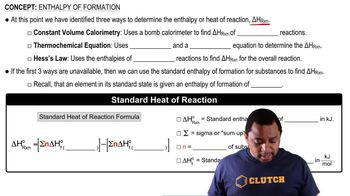
Enthalpy of Formation

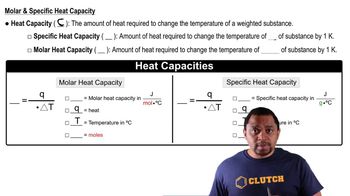
Specific Heat Capacity

Specific heat capacity is the amount of heat required to raise the temperature of a unit mass of a substance by one degree Celsius. In this problem, the specific heat of the solution is assumed to be the same as that of water, which is 4.18 J/g°C. This value is crucial for calculating the heat absorbed by the solution when sodium hydroxide dissolves and the temperature changes.
추천 영상:

Calorimetry

Calorimetry is the science of measuring the heat of chemical reactions or physical changes. In this scenario, a coffee-cup calorimeter is used to measure the temperature change of the solution, which allows for the calculation of the heat transfer associated with the dissolution of sodium hydroxide. Understanding calorimetry principles is essential for accurately determining the enthalpy change of the solution process.
추천 영상:
가이드 코스
00:50
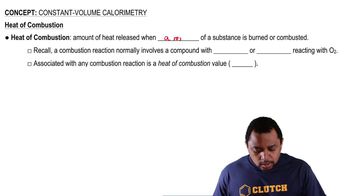
Constant-Volume Calorimetry