Ch.5 - Thermochemistry
Brown - Chemistry: The Central Science 14th Edition
Brown14th EditionChemistry: The Central ScienceISBN: 9780134414232당신이 사용하는 게 아니라요?교과서 변경
5장, 문제 109

Burning acetylene in oxygen can produce three different carbon-containing products: soot (very fine particles of graphite), CO(g), and CO2(g). (a) Write three balanced equations for the reaction of acetylene gas with oxygen to produce these three products. In each case assume that H2O(l) is the only other product. Determine the standard enthalpies for the reactions in part (a).

검증된 단계별 안내
1
Step 1: Write the balanced chemical equation for the complete combustion of acetylene (C2H2) to produce carbon dioxide (CO2) and water (H2O). The general form is: C2H2 + O2 -> CO2 + H2O. Balance the equation by ensuring the number of atoms of each element is equal on both sides.
Step 2: Write the balanced chemical equation for the incomplete combustion of acetylene to produce carbon monoxide (CO) and water (H2O). The general form is: C2H2 + O2 -> CO + H2O. Balance the equation by adjusting the coefficients to ensure the conservation of mass.
Step 3: Write the balanced chemical equation for the combustion of acetylene to produce soot (graphite, C) and water (H2O). The general form is: C2H2 + O2 -> C + H2O. Balance the equation by ensuring the number of carbon, hydrogen, and oxygen atoms are equal on both sides.
Step 4: Determine the standard enthalpy change (ΔH°) for each reaction. Use standard enthalpy of formation values from a data table for each reactant and product. Apply Hess's Law: ΔH° = ΣΔH°f(products) - ΣΔH°f(reactants).
Step 5: Calculate the standard enthalpy change for each reaction using the balanced equations and the standard enthalpy of formation values. This involves substituting the values into the equation from Step 4 and performing the arithmetic to find ΔH° for each reaction.

주요 개념

질문에 올바르게 답하기 위해 반드시 이해해야 하는 핵심 개념들은 다음과 같습니다.

Combustion Reactions

Combustion reactions involve the reaction of a fuel with an oxidant, typically oxygen, resulting in the release of energy. In the case of acetylene (C2H2), it can combust completely to form carbon dioxide (CO2) and water (H2O), or partially to produce carbon monoxide (CO) and soot. Understanding the stoichiometry of these reactions is essential for writing balanced chemical equations.
추천 영상:
가이드 코스
02:24
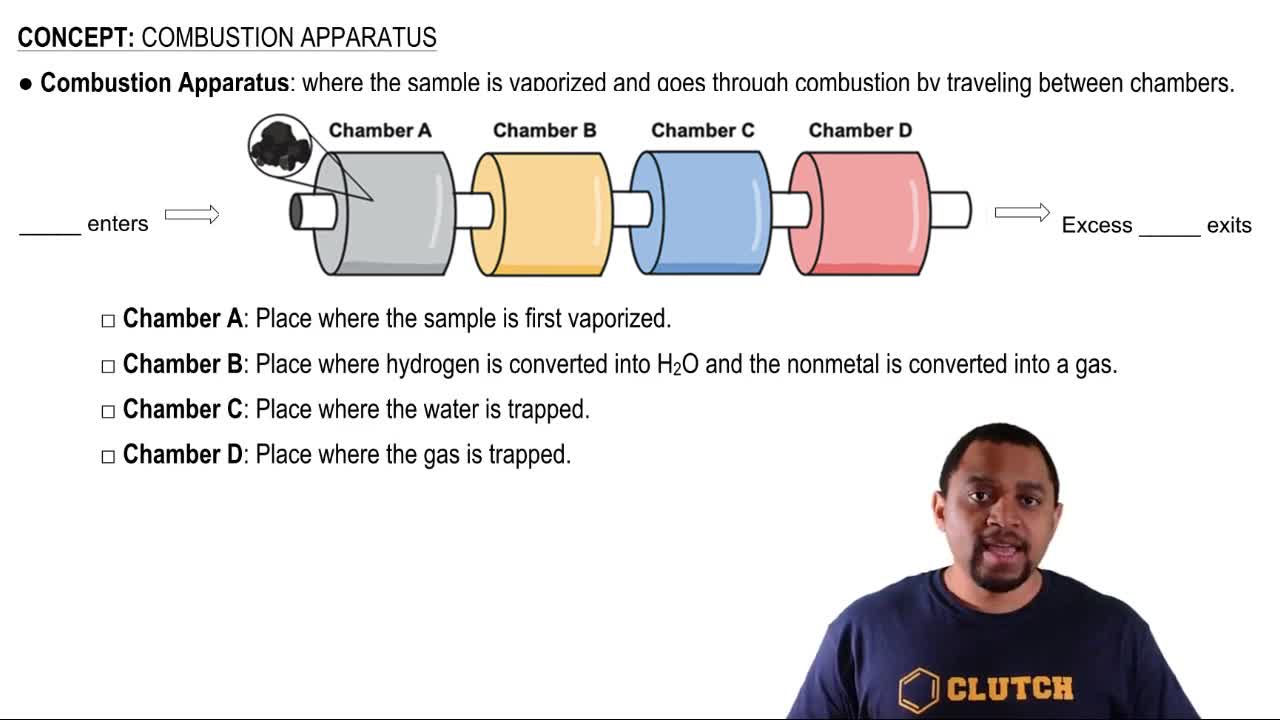
Combustion Apparatus

Balancing Chemical Equations

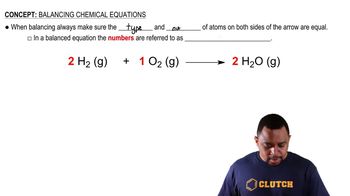
Balancing chemical equations is a fundamental skill in chemistry that ensures the law of conservation of mass is upheld. This involves adjusting the coefficients of reactants and products so that the number of atoms of each element is the same on both sides of the equation. For the combustion of acetylene, this means carefully counting and adjusting the carbon, hydrogen, and oxygen atoms to reflect the products formed.
추천 영상:
가이드 코스
01:32
Balancing Chemical Equations

Standard Enthalpy of Reaction

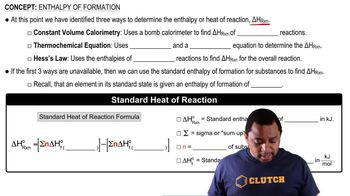
The standard enthalpy of reaction (ΔH°) is the heat change that occurs when reactants are converted to products under standard conditions (1 atm pressure and 25°C). It is crucial for understanding the energy changes associated with chemical reactions, including combustion. Calculating ΔH° for the combustion of acetylene requires knowledge of the enthalpies of formation for the reactants and products involved.
추천 영상:
가이드 코스
02:34
Enthalpy of Formation