
Ch.5 - Thermochemistry
Brown - Chemistry: The Central Science 14th Edition
Brown14th EditionChemistry: The Central ScienceISBN: 9780134414232당신이 사용하는 게 아니라요?교과서 변경
5장, 문제 61

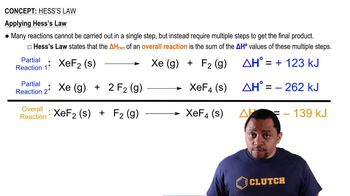
Can you use an approach similar to Hess’s law to calculate the change in internal energy, _x001F_E, for an overall reaction by summing the _x001F_E values of individual reactions that add up to give the desired overall reaction?

검증된 단계별 안내
1
Identify the target overall reaction for which you want to calculate the change in internal energy, \( \Delta E \).
List the individual reactions that, when combined, will yield the overall reaction. Ensure that these reactions are balanced.
For each individual reaction, note the given \( \Delta E \) values. These are typically provided or can be found in tables of thermodynamic data.
Adjust the \( \Delta E \) values of the individual reactions as necessary. If you reverse a reaction, change the sign of \( \Delta E \). If you multiply a reaction by a coefficient, multiply the \( \Delta E \) by the same coefficient.
Sum the adjusted \( \Delta E \) values of the individual reactions to find the \( \Delta E \) for the overall reaction. This is analogous to Hess's Law, which states that the total enthalpy change for a reaction is the sum of the enthalpy changes for each step.

주요 개념

질문에 올바르게 답하기 위해 반드시 이해해야 하는 핵심 개념들은 다음과 같습니다.

Hess's Law

Hess's Law states that the total enthalpy change for a reaction is the sum of the enthalpy changes for the individual steps of the reaction, regardless of the pathway taken. This principle allows chemists to calculate the enthalpy change of a complex reaction by breaking it down into simpler reactions with known enthalpy changes.
추천 영상:

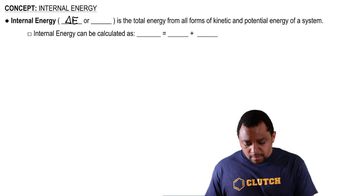
Internal Energy

Internal energy is the total energy contained within a system, including kinetic and potential energy of the particles. It is a state function, meaning its change depends only on the initial and final states of the system, not on the path taken. Understanding internal energy is crucial for analyzing thermodynamic processes and reactions.
추천 영상:
가이드 코스
00:40
Internal Energy

State Functions

State functions are properties of a system that depend only on its current state, not on how it reached that state. Examples include internal energy, enthalpy, and entropy. In thermodynamics, state functions allow for the simplification of calculations, as changes in these properties can be determined from initial and final conditions without needing to consider the specific process.
추천 영상:
가이드 코스
03:37
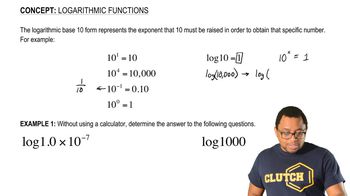
Logarithmic Functions
관련 실천
교과서 질문

Under constant-volume conditions, the heat of combustion of benzoic acid (C6H5O6) is 15.57 kJ/g. A 3.500-g sample of sucrose is burned in a bomb calorimeter. The temperature of the calorimeter increases from 20.94 to 24.72 °C. (a) What is the total heat capacity of the calorimeter?

1939
views
교과서 질문

Under constant-volume conditions, the heat of combustion of benzoic acid (C6H5O6) is 15.57 kJ/g. A 3.500-g sample of sucrose is burned in a bomb calorimeter. The temperature of the calorimeter increases from 20.94 to 24.72 °C. (b) If the size of the sucrose sample had been exactly twice as large, what would the temperature change of the calorimeter have been?

1040
views
교과서 질문

Consider the following hypothetical reactions: A → B ΔHI = +60 kJ B → C ΔHII = -90 kJ (a) Use Hess’s law to calculate the enthalpy change for the reaction A → C.

3
views
교과서 질문

Under constant-volume conditions, the heat of combustion of naphthalene (C10H8) is 40.18 kJ/g. A 2.50-g sample of naphthalene is burned in a bomb calorimeter. The temperature of the calorimeter increases from 21.50 to 28.83 °C. (c) Suppose that in changing samples, a portion of the water in the calorimeter were lost. In what way, if any, would this change the heat capacity of the calorimeter?

1165
views
교과서 질문

Consider the following hypothetical reactions: A → B ΔHI = +60 kJ B → C ΔHII = -90 kJ (b) Construct an enthalpy diagram for substances A, B, and C, and show how Hess's law applies.

1311
views
교과서 질문

Calculate the enthalpy change for the reaction P4O6(s) + 2 O2(g) → P4O10(s) given the following enthalpies of reaction: P4(s) + 3 O2(g) → P4O6(s) ΔH = -1640.1 kJ P4(s) + 5 O2(g) → P4O10(s) ΔH = -2940.1 kJ

1298
views