
Ch.5 - Thermochemistry
Brown - Chemistry: The Central Science 14th Edition
Brown14th EditionChemistry: The Central ScienceISBN: 9780134414232당신이 사용하는 게 아니라요?교과서 변경
5장, 문제 62a

Consider the following hypothetical reactions: A → B ΔHI = +60 kJ B → C ΔHII = -90 kJ (a) Use Hess’s law to calculate the enthalpy change for the reaction A → C.

검증된 단계별 안내
1
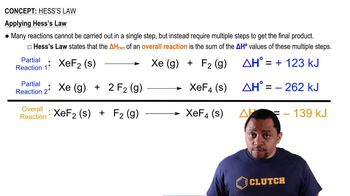
Understand Hess's Law: It states that the total enthalpy change for a reaction is the same, no matter how many steps the reaction is carried out in. This means we can add the enthalpy changes of individual steps to find the overall enthalpy change.
Identify the given reactions and their enthalpy changes: The first reaction is A → B with ΔH = +60 kJ, and the second reaction is B → C with ΔH = -90 kJ.
Write the target reaction: We need to find the enthalpy change for the reaction A → C.
Apply Hess's Law: Add the enthalpy changes of the given reactions to find the enthalpy change for the target reaction. This involves summing the enthalpy changes: ΔH (A → C) = ΔH (A → B) + ΔH (B → C).
Substitute the given values into the equation: ΔH (A → C) = +60 kJ + (-90 kJ). Calculate the sum to find the overall enthalpy change for the reaction A → C.

비슷한 문제에 대한 검증된 영상 답변:

이 영상 해법은 위 문제에 도움이 된다고 튜터들이 추천한 것입니다.
영상 길이:
2m

주요 개념

질문에 올바르게 답하기 위해 반드시 이해해야 하는 핵심 개념들은 다음과 같습니다.

Hess's Law

Hess's Law states that the total enthalpy change for a chemical reaction is the sum of the enthalpy changes for the individual steps of the reaction, regardless of the pathway taken. This principle allows us to calculate the enthalpy change for a reaction by combining the enthalpy changes of related reactions, making it a powerful tool in thermochemistry.
추천 영상:

Enthalpy Change (ΔH)

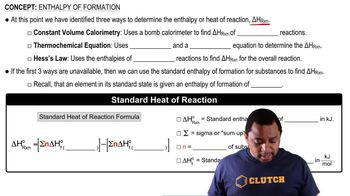
Enthalpy change (ΔH) is a measure of the heat content of a system at constant pressure. It indicates whether a reaction is exothermic (releases heat, ΔH < 0) or endothermic (absorbs heat, ΔH > 0). Understanding the sign and magnitude of ΔH is crucial for predicting the energy changes associated with chemical reactions.
추천 영상:
가이드 코스
02:34
Enthalpy of Formation

Thermochemical Equations

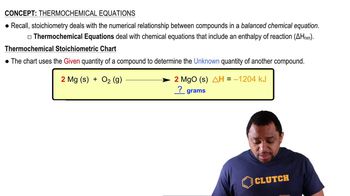
Thermochemical equations represent chemical reactions along with their associated enthalpy changes. These equations provide essential information about the energy changes that occur during reactions, allowing chemists to analyze and predict the heat exchange involved in various processes. Properly balancing these equations is vital for accurate calculations using Hess's Law.
추천 영상:
가이드 코스
01:13
Thermochemical Equations