
Ch.5 - Thermochemistry
Brown - Chemistry: The Central Science 14th Edition
Brown14th EditionChemistry: The Central ScienceISBN: 9780134414232당신이 사용하는 게 아니라요?교과서 변경
5장, 문제 122

Consider the following acid-neutralization reactions involving the strong base NaOH(aq): HNO31aq2 + NaOH1aq2¡NaNO31aq2 + H2O1l2 HCl1aq2 + NaOH1aq2¡NaCl1aq2 + H2O1l2 NH4+1aq2 + NaOH1aq2¡NH31aq2 + Na+1aq2 + H2O1l2 (d) In the third equation NH4 +1aq2 is acting as an acid. Based on the value of H° for this reaction, do you think it is a strong or a weak acid? Explain.

검증된 단계별 안내
1
Identify the reaction type: The reaction involving NH4+ and NaOH is an acid-base neutralization reaction.
Analyze the products: The products of the reaction are NH3 (ammonia), Na+ (sodium ion), and H2O (water). The formation of NH3, a weak base, suggests the reactant NH4+ is its conjugate acid.
Understand the role of NH4+: In this reaction, NH4+ donates a proton (H+) to the OH- ion from NaOH, forming water and NH3. This behavior is characteristic of an acid.
Consider the strength of NH4+ as an acid: Strong acids typically dissociate completely in water to form stable, non-reactive conjugate bases. NH3, however, is known to be a weak base that can accept a proton under certain conditions, indicating NH4+ is a weak acid.
Relate to the enthalpy change (H°): If the reaction enthalpy (H°) is not highly negative, it suggests that the reaction does not proceed with a significant release of energy, typical of weak acid reactions with weak bases.

비슷한 문제에 대한 검증된 영상 답변:

이 영상 해법은 위 문제에 도움이 된다고 튜터들이 추천한 것입니다.
영상 길이:
3m
도움이 되었나요?

주요 개념

질문에 올바르게 답하기 위해 반드시 이해해야 하는 핵심 개념들은 다음과 같습니다.

Acid-Base Theory

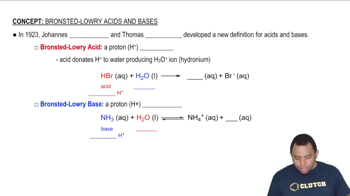
Acid-base theory explains the behavior of acids and bases in chemical reactions. According to the Brønsted-Lowry theory, acids are proton donors, while bases are proton acceptors. In the given reaction, NH4+ acts as an acid by donating a proton to NaOH, forming NH3 and water. Understanding this theory is crucial for identifying the role of substances in acid-base reactions.
추천 영상:
가이드 코스
02:08
Bronsted-Lowry Acid-Base Theory

Strength of Acids

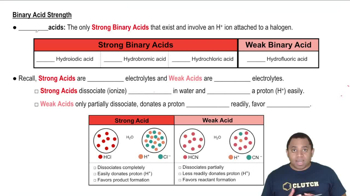
The strength of an acid is determined by its ability to dissociate in solution and release protons (H+ ions). Strong acids, like HCl and HNO3, completely dissociate in water, while weak acids, like NH4+, only partially dissociate. The degree of dissociation can be inferred from the reaction's enthalpy change (ΔH°), which indicates whether the reaction is favorable and how readily the acid donates protons.
추천 영상:
가이드 코스
03:51
Binary Acid Strengths

Enthalpy Change (ΔH°)

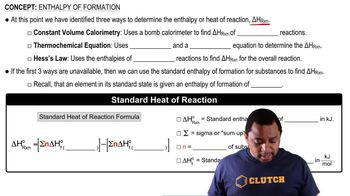
Enthalpy change (ΔH°) is a measure of the heat absorbed or released during a chemical reaction at constant pressure. A negative ΔH° indicates that the reaction is exothermic, suggesting that the products are more stable than the reactants. In the context of acid strength, a significant release of energy when NH4+ donates a proton may imply that it is a weak acid, as strong acids typically have more favorable dissociation energetics.
추천 영상:
가이드 코스
02:34
Enthalpy of Formation
관련 실천
교과서 질문

Consider two solutions, the first being 50.0 mL of 1.00 M CuSO4 and the second 50.0 mL of 2.00 M KOH. When the two solutions are mixed in a constant-pressure calorimeter, a precipitate forms and the temperature of the mixture rises from 21.5 to 27.7 °C (d) From the calorimetric data, calculate ΔH for the reaction that occurs on mixing. Assume that the calorimeter absorbs only a negligible quantity of heat, that the total volume of the solution is 100.0 mL, and that the specific heat and density of the solution after mixing are the same as those of pure water.

1
views
교과서 질문

Consider the following unbalanced oxidation-reduction reactions in aqueous solution:

Ag+(aq) + Li(s) → Ag(s) + Li+(aq)

Fe(s) + Na+(aq) → Fe2+(aq) + Na(s)

K(s) + H2O(l) → KOH(aq) + H2(g)

(d) Use the activity series to predict which of these reactions should occur. (Section 4.4) Are these results in accord with your conclusion in part (c) of this problem?

교과서 질문

Consider two solutions, the first being 50.0 mL of 1.00 M CuSO4 and the second 50.0 mL of 2.00 M KOH. When the two solutions are mixed in a constant-pressure calorimeter, a precipitate forms and the temperature of the mixture rises from 21.5 to 27.7 °C. (a) Before mixing, how many grams of Cu are present in the solution of CuSO4?

980
views
교과서 질문

Consider the following unbalanced oxidation-reduction reactions in aqueous solution:

Ag+(aq) + Li(s) → Ag(s) + Li+(aq)

Fe(s) + Na+(aq) → Fe2+(aq) + Na(s)

K(s) + H2O(l) → KOH(aq) + H2(g)

(a) Balance third reaction.

609
views
교과서 질문

Consider the following unbalanced oxidation-reduction reactions in aqueous solution:

Ag+(aq) + Li(s) → Ag(s) + Li+(aq)

Fe(s) + Na+(aq) → Fe2+(aq) + Na(s)

K(s) + H2O(l) → KOH(aq) + H2(g)

(a) Balance second reaction.

681
views