
Ch.5 - Thermochemistry
Brown - Chemistry: The Central Science 14th Edition
Brown14th EditionChemistry: The Central ScienceISBN: 9780134414232당신이 사용하는 게 아니라요?교과서 변경
5장, 문제 121a3

Consider the following unbalanced oxidation-reduction reactions in aqueous solution:
Ag+(aq) + Li(s) → Ag(s) + Li+(aq)
Fe(s) + Na+(aq) → Fe2+(aq) + Na(s)
K(s) + H2O(l) → KOH(aq) + H2(g)
(a) Balance third reaction.

검증된 단계별 안내
1
Identify the oxidation and reduction half-reactions in the given equation: \( \text{K(s)} + \text{H}_2\text{O(l)} \rightarrow \text{KOH(aq)} + \text{H}_2\text{(g)} \).
Write the oxidation half-reaction: Potassium (K) is oxidized to potassium hydroxide (KOH).
Write the reduction half-reaction: Water (H₂O) is reduced to hydrogen gas (H₂).
Balance the atoms in each half-reaction. For the oxidation half-reaction, balance K atoms. For the reduction half-reaction, balance H and O atoms.
Combine the balanced half-reactions, ensuring that the electrons lost in the oxidation half-reaction equal the electrons gained in the reduction half-reaction.

비슷한 문제에 대한 검증된 영상 답변:

이 영상 해법은 위 문제에 도움이 된다고 튜터들이 추천한 것입니다.
영상 길이:
6m
도움이 되었나요?

주요 개념

질문에 올바르게 답하기 위해 반드시 이해해야 하는 핵심 개념들은 다음과 같습니다.

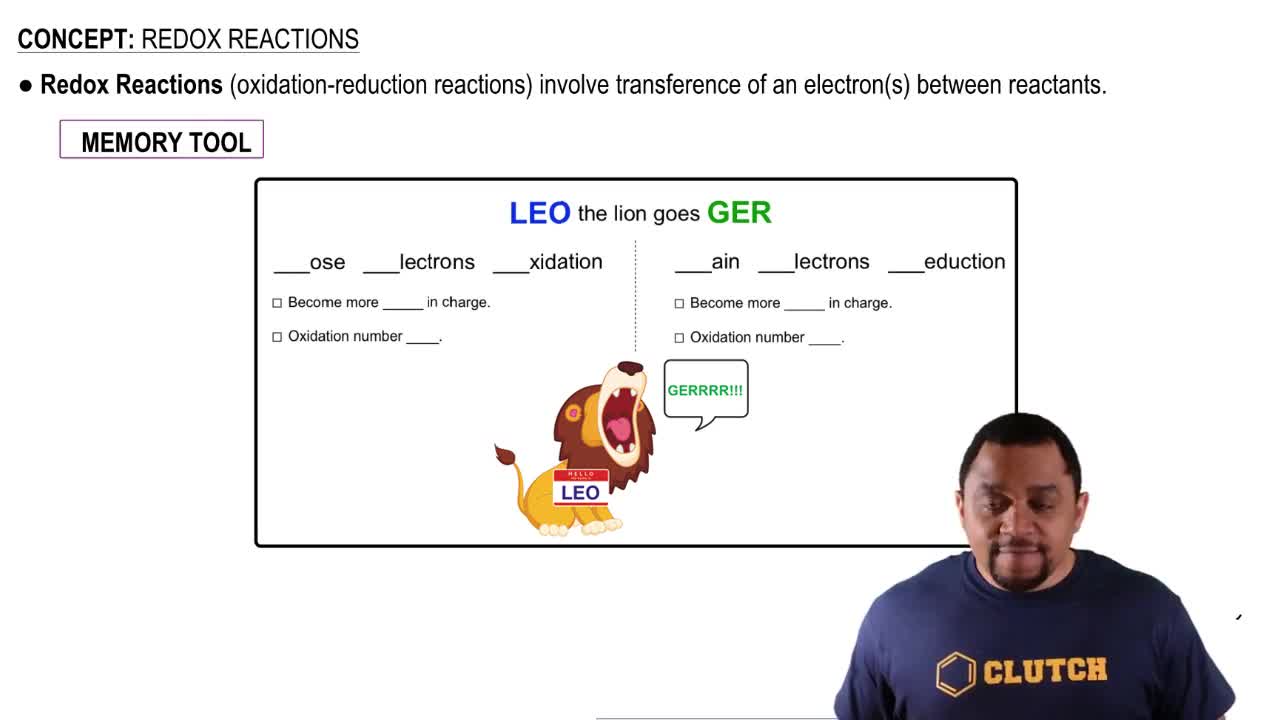
Oxidation-Reduction Reactions

Oxidation-reduction (redox) reactions involve the transfer of electrons between species, resulting in changes in oxidation states. In these reactions, one species is oxidized (loses electrons) while another is reduced (gains electrons). Understanding the roles of oxidizing and reducing agents is crucial for balancing these reactions.
추천 영상:
가이드 코스
01:53
Oxidation and Reduction Reactions

Balancing Chemical Equations

Balancing chemical equations requires ensuring that the number of atoms for each element is the same on both sides of the equation. This is achieved by adjusting coefficients in front of the compounds. For redox reactions, it often involves balancing both the mass and the charge, which can be done using half-reaction methods.
추천 영상:
가이드 코스
01:32
Balancing Chemical Equations

Half-Reactions

Half-reactions are used to separate the oxidation and reduction processes in a redox reaction. Each half-reaction shows the transfer of electrons and the change in oxidation states for the species involved. By balancing the half-reactions individually and then combining them, one can achieve a balanced overall reaction.
추천 영상:
가이드 코스
01:49
First-Order Half-Life
관련 실천
교과서 질문

Consider the following unbalanced oxidation-reduction reactions in aqueous solution:

Ag+(aq) + Li(s) → Ag(s) + Li+(aq)

Fe(s) + Na+(aq) → Fe2+(aq) + Na(s)

K(s) + H2O(l) → KOH(aq) + H2(g)

(d) Use the activity series to predict which of these reactions should occur. (Section 4.4) Are these results in accord with your conclusion in part (c) of this problem?

교과서 질문

Suppose an Olympic diver who weighs 52.0 kg executes a straight dive from a 10-m platform. At the apex of the dive, the diver is 10.8 m above the surface of the water. (b) Assuming that all the potential energy of the diver is converted into kinetic energy at the surface of the water, at what speed, in m/s, will the diver enter the water?

592
views
교과서 질문
Consider the following acid-neutralization reactions involving the strong base NaOH(aq): HNO31aq2 + NaOH1aq2¡NaNO31aq2 + H2O1l2 HCl1aq2 + NaOH1aq2¡NaCl1aq2 + H2O1l2 NH4+1aq2 + NaOH1aq2¡NH31aq2 + Na+1aq2 + H2O1l2 (d) In the third equation NH4 +1aq2 is acting as an acid. Based on the value of H° for this reaction, do you think it is a strong or a weak acid? Explain.
739
views
교과서 질문

Consider the following unbalanced oxidation-reduction reactions in aqueous solution:

Ag+(aq) + Li(s) → Ag(s) + Li+(aq)

Fe(s) + Na+(aq) → Fe2+(aq) + Na(s)

K(s) + H2O(l) → KOH(aq) + H2(g)

(a) Balance second reaction.

681
views
교과서 질문

Suppose an Olympic diver who weighs 52.0 kg executes a straight dive from a 10-m platform. At the apex of the dive, the diver is 10.8 m above the surface of the water. (a) What is the potential energy of the diver at the apex of the dive, relative to the surface of the water?

405
views