


Sucrose (C12H22O11) is produced by plants as follows: 12 CO2(g) + 11 H2O(l) → C12H22O11 + 12 O2(g) H = 5645 kJ About 4.8 g of sucrose is produced per day per square meter of the earth's surface. The energy for this endothermic reaction is supplied by the sunlight. About 0.1 % of the sunlight that reaches the earth is used to produce sucrose. Calculate the total energy the sun supplies for each square meter of surface area. Give your answer in kilowatts per square meter 1kW/m2 where 1W = 1 J/s2.
Ch.5 - Thermochemistry
5장, 문제 117
It is estimated that the net amount of carbon dioxide fixed by photosynthesis on the landmass of Earth is 5.5 * 10^16 g/yr of CO2. Assume that all this carbon is converted into glucose. (b) Calculate the average rate of conversion of solar energy into plant energy in megawatts, MW (1 W = 1 J/s). A large nuclear power plant produces about 10^3 MW. The energy of how many such nuclear power plants is equivalent to the solar energy conversion?
검증된 단계별 안내1
Step 1: Determine the moles of CO2 fixed per year. Use the molar mass of CO2 (44.01 g/mol) to convert the given mass of CO2 (5.5 * 10^16 g/yr) into moles.
Step 2: Use the balanced chemical equation for photosynthesis: 6 CO2 + 6 H2O -> C6H12O6 + 6 O2. From this equation, determine the moles of glucose (C6H12O6) produced from the moles of CO2 calculated in Step 1.
Step 3: Calculate the energy stored in glucose. The combustion of glucose releases approximately 2800 kJ/mol. Use this value to find the total energy stored in the glucose produced per year.
Step 4: Convert the total energy from kilojoules to joules (1 kJ = 1000 J) and then to watts (1 W = 1 J/s). Since the energy is per year, convert the time to seconds (1 year = 365 days * 24 hours/day * 3600 seconds/hour).
Step 5: Calculate the equivalent number of nuclear power plants. Divide the average rate of conversion of solar energy (in MW) by the power output of a large nuclear power plant (10^3 MW) to find the number of such plants needed to match the solar energy conversion.
주요 개념
질문에 올바르게 답하기 위해 반드시 이해해야 하는 핵심 개념들은 다음과 같습니다.
Photosynthesis and Carbon Fixation
Photosynthesis is the process by which green plants, algae, and some bacteria convert light energy into chemical energy, primarily in the form of glucose, using carbon dioxide and water. The net amount of carbon dioxide fixed during this process is a measure of how much CO2 is converted into organic compounds, which is essential for understanding the energy conversion efficiency of plants.
추천 영상:
가이드 코스
3 and 4 Carbon Alkyls
Energy Conversion and Units
Energy conversion refers to the process of changing energy from one form to another, such as converting solar energy into chemical energy during photosynthesis. In this context, energy is measured in joules (J), and power, which is the rate of energy conversion, is measured in watts (W), where 1 W equals 1 J/s. Understanding these units is crucial for calculating the average rate of energy conversion.
추천 영상:
가이드 코스
Conversion Factors
Comparative Energy Analysis
Comparative energy analysis involves evaluating different energy sources and their outputs. In this question, the energy produced by photosynthesis is compared to that of nuclear power plants, which produce energy in megawatts (MW). This comparison helps to contextualize the scale of energy conversion in plants relative to large-scale energy production facilities.
추천 영상:
가이드 코스
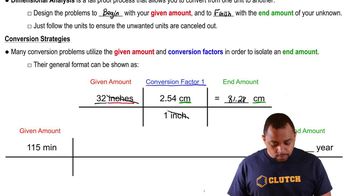
Dimensional Analysis
관련 실천
교과서 질문
833
views
교과서 질문
At 25 °C (approximately room temperature) the rms velocity of an Ar atom in air is 1553 km/h. (c) What is the total kinetic energy of 1 mol of Ar atoms moving at this speed?
1
views
교과서 질문
At 20 °C (approximately room temperature) the average velocity of N2 molecules in air is 1050 mph. (b) What is the kinetic energy (in J) of an N2 molecule moving at this speed?
1356
views
1
comments
교과서 질문
A 201-lb man decides to add to his exercise routine by walking up three flights of stairs (45 ft) 20 times per day. Hefigures that theworkrequired to increasehis potential energy in this way will permit him to eat an extra order of French fries, at 245 Cal, without adding to his weight. Is he correct in this assumption?
357
views
