
Ch.5 - Thermochemistry
Brown - Chemistry: The Central Science 14th Edition
Brown14th EditionChemistry: The Central ScienceISBN: 9780134414232당신이 사용하는 게 아니라요?교과서 변경
5장, 문제 84a

Use bond enthalpies in Table 5.4 to estimate H for each of the following reactions: (a)

검증된 단계별 안내
1
Identify the bonds broken and formed in the reaction. Breaking bonds requires energy (endothermic), while forming bonds releases energy (exothermic).
Use the bond enthalpy values from Table 5.4 to calculate the total energy required to break all the bonds in the reactants.
Calculate the total energy released by forming all the bonds in the products using the bond enthalpy values.
Subtract the total energy released (from forming bonds) from the total energy required (for breaking bonds) to find the overall change in enthalpy (ΔH) for the reaction.
Remember that a negative ΔH indicates an exothermic reaction, while a positive ΔH indicates an endothermic reaction.

비슷한 문제에 대한 검증된 영상 답변:

이 영상 해법은 위 문제에 도움이 된다고 튜터들이 추천한 것입니다.
영상 길이:
8m
도움이 되었나요?

주요 개념

질문에 올바르게 답하기 위해 반드시 이해해야 하는 핵심 개념들은 다음과 같습니다.

Bond Enthalpy

Bond enthalpy, or bond dissociation energy, is the amount of energy required to break a bond in a molecule in the gas phase. It is typically expressed in kilojoules per mole (kJ/mol) and varies depending on the type of bond and the surrounding atoms. Understanding bond enthalpy is crucial for estimating the energy changes in chemical reactions, as it allows for the calculation of the total energy required to break bonds in reactants and the energy released when new bonds are formed in products.
추천 영상:
가이드 코스
02:34
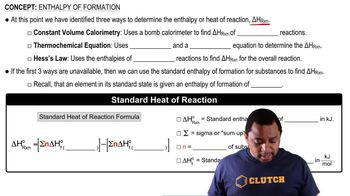
Enthalpy of Formation

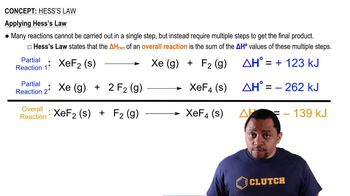
Hess's Law

Hess's Law states that the total enthalpy change for a reaction is the same, regardless of the number of steps taken to achieve the reaction. This principle allows chemists to calculate the enthalpy change of a reaction by summing the enthalpy changes of individual steps, which can be particularly useful when direct measurement is difficult. In the context of using bond enthalpies, Hess's Law enables the estimation of the overall reaction enthalpy by considering the bonds broken and formed.
추천 영상:

Reaction Enthalpy (ΔH)

The reaction enthalpy, denoted as ΔH, represents the change in enthalpy during a chemical reaction. It can be calculated using the formula ΔH = Σ(bond enthalpies of bonds broken) - Σ(bond enthalpies of bonds formed). A positive ΔH indicates an endothermic reaction (energy absorbed), while a negative ΔH indicates an exothermic reaction (energy released). Understanding how to calculate ΔH using bond enthalpies is essential for predicting the energy dynamics of chemical reactions.
추천 영상:
가이드 코스
02:34
Enthalpy of Formation