
Ch.5 - Thermochemistry
Brown - Chemistry: The Central Science 14th Edition
Brown14th EditionChemistry: The Central ScienceISBN: 9780134414232당신이 사용하는 게 아니라요?교과서 변경
5장, 문제 82

Without doing any calculations, predict the sign of _x001F_H for each of the following reactions: (a) 2 NO2(g) → N2O4(g) (b) 2 F(g) → F2(g) (c) Mg2+(g) + 2 Cl-(g) → MgCl2(s) (d) HBr(g) → H(g) + Br(g)

검증된 단계별 안내
1
Consider the reaction (a) 2 NO2(g) → N2O4(g). This reaction involves the combination of two gas molecules into one, which typically results in a decrease in entropy. Since the reaction forms a more ordered state, it is likely exothermic, suggesting a negative ΔH.
For reaction (b) 2 F(g) → F2(g), two fluorine atoms combine to form a diatomic molecule. Bond formation releases energy, making the reaction exothermic, so ΔH is expected to be negative.
In reaction (c) Mg2+(g) + 2 Cl-(g) → MgCl2(s), gaseous ions form a solid ionic compound. The formation of ionic bonds from gaseous ions is highly exothermic due to the release of lattice energy, indicating a negative ΔH.
For reaction (d) HBr(g) → H(g) + Br(g), a diatomic molecule is dissociated into atoms. Breaking bonds requires energy input, making the reaction endothermic, so ΔH is expected to be positive.
In summary, reactions that involve bond formation or a transition to a more ordered state (like forming a solid from gases) are typically exothermic (negative ΔH), while reactions that involve bond breaking are endothermic (positive ΔH).

주요 개념

질문에 올바르게 답하기 위해 반드시 이해해야 하는 핵심 개념들은 다음과 같습니다.

Enthalpy Change (_x001F_H)

Enthalpy change (_x001F_H) is a measure of the heat content of a system at constant pressure. It indicates whether a reaction absorbs heat (endothermic, _x001F_H > 0) or releases heat (exothermic, _x001F_H < 0). Understanding the nature of the reactants and products, as well as their states (gas, liquid, solid), is crucial for predicting the sign of _x001F_H in a reaction.
추천 영상:
가이드 코스
02:34
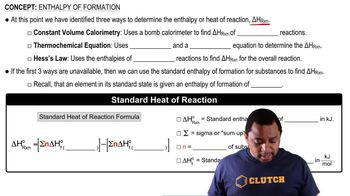
Enthalpy of Formation

Phase Changes and Stability

The stability of reactants and products in different phases (gas, liquid, solid) affects the enthalpy change. Generally, reactions that produce a more stable phase (like a solid from gases) tend to release energy, resulting in a negative _x001F_H. Conversely, reactions that involve breaking stable bonds or forming less stable phases may absorb energy, leading to a positive _x001F_H.
추천 영상:
가이드 코스
01:46
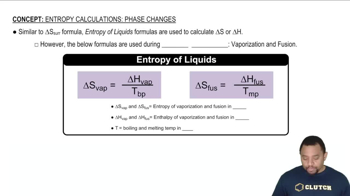
Entropy in Phase Changes

Bond Formation and Breaking

The energy associated with bond formation and breaking is fundamental in determining the enthalpy change of a reaction. Forming bonds releases energy (exothermic), while breaking bonds requires energy input (endothermic). Analyzing the bonds in the reactants and products helps predict whether the overall reaction will be exothermic or endothermic, thus indicating the sign of _x001F_H.
추천 영상:
가이드 코스
01:41
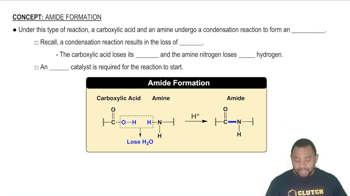
Amide Formation